What Is Gravesand’s Apparatus?
Gravesand’s apparatus, also known as a parallelogram law apparatus, is a physics laboratory apparatus used to study the composition and equilibrium of concurrent forces and demonstrate the parallelogram law of forces.
The apparatus provides a visual and practical way to observe how two forces acting simultaneously at a point can be represented by a single resultant force. It is commonly used for physics experiments and educational demonstrations in laboratories and science classrooms.
Principle of the Parallelogram Law of Forces
The parallelogram law of forces states that if two forces acting simultaneously at a point are represented in magnitude and direction by two adjacent sides of a parallelogram, their resultant is represented in magnitude and direction by the diagonal of the parallelogram passing through that point.
For two forces P and Q acting at an angle θ, the magnitude of the resultant R can be expressed as:
R = √(P² + Q² + 2PQ cos θ)
The direction of the resultant depends on the magnitudes of the two forces and the angle between them.
How Does Gravesand’s Apparatus Work?
In a typical experiment, forces are applied through strings passing over pulleys and connected to weight hangers. The strings meet at a common point, allowing the forces acting in different directions to reach equilibrium.
By observing the directions of the strings and the applied loads, students can represent the forces graphically and verify the relationship between the two applied forces and their resultant according to the parallelogram law.
Gravesand’s Apparatus Components
| Component |
Purpose |
| Demonstration Board |
Provides the main surface for arranging and observing the force system. |
| Two Pulleys with Clamps |
Guide the strings and allow forces to act in different directions. |
| Iron Nickel-Plated Hangers |
Hold the slotted weights used to apply forces during the experiment. |
| Three 250 g Slotted Weights |
Provide known loads for demonstrating and studying the relationship between forces. |
Technical Specifications
| Specification |
Detail |
| Product Name |
Gravesand’s Apparatus / Parallelogram Law Apparatus |
| Primary Application |
Demonstration of the parallelogram law of forces and study of concurrent forces |
| Panel Size |
26 × 20 × 0.5 inches |
| Pulleys |
Two pulleys mounted on clamps |
| Hangers |
Iron, nickel-plated |
| Slotted Weights |
Three weights of 250 g each |
| Mounting |
Suitable for wall mounting |
| Suitable For |
Physics laboratories, science classrooms and educational demonstrations |
How to Perform the Parallelogram Law Experiment
- Set up the apparatus. Position the board securely and arrange the pulleys according to the experimental procedure.
- Connect the strings and hangers. Arrange the strings so that the applied forces meet at a common point.
- Add suitable weights. Place the required slotted weights on the hangers to apply known forces.
- Establish equilibrium. Adjust the arrangement until the force system reaches the required equilibrium condition.
- Record the force directions. Mark or observe the directions in which the strings act.
- Construct the force diagram. Represent the forces to scale and complete the parallelogram using the measured directions.
- Determine the resultant. Compare the diagonal of the parallelogram with the balancing or resultant force according to the experimental method being followed.
Experimental procedures may vary by curriculum or laboratory manual. Students should follow the prescribed method and laboratory instructions provided by their institution.
Gravesand’s Apparatus Diagram and Force Representation
A typical Gravesand’s apparatus diagram shows forces acting along strings that meet at a common point, with each string passing over a pulley and carrying a load. The directions of these forces can be represented as vectors and used to construct a parallelogram of forces.
For the best educational value, the physical apparatus allows students to connect the abstract vector diagram with an observable force system. This makes it useful for understanding resultant force, vector addition and equilibrium through practical demonstration.
Applications of the Parallelogram Law Apparatus
- Demonstrating the parallelogram law of forces.
- Studying the composition of concurrent forces.
- Understanding resultant force and vector addition.
- Performing practical experiments involving equilibrium of forces.
- Supporting classroom demonstrations of force vectors and mechanics principles.
- Physics practical work in schools, colleges and educational laboratories.
About the SamTech Parallelogram Law Apparatus
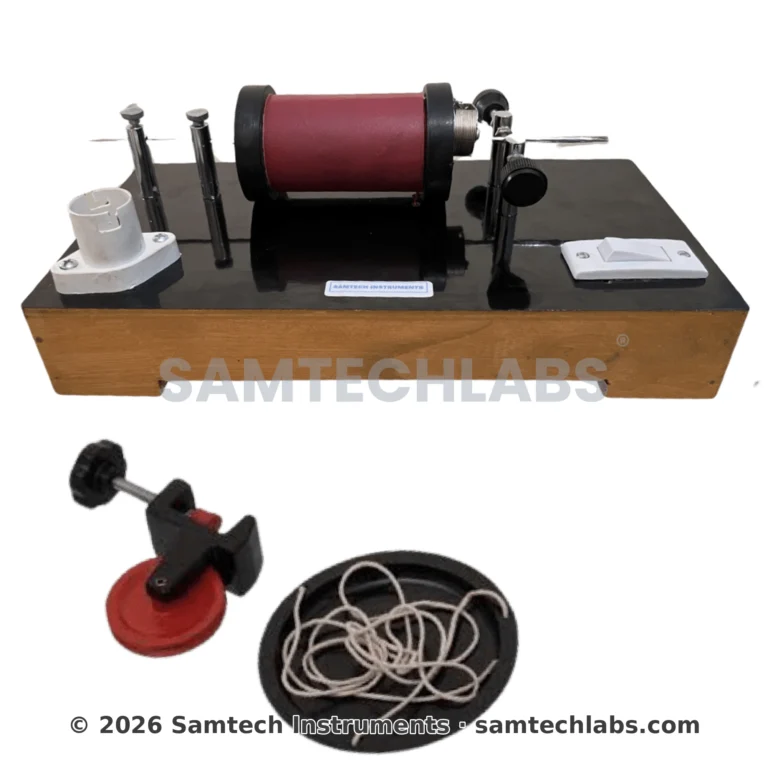
The SamTech Parallelogram Law Apparatus provides a visual and practical method for studying the relationship between forces. The set includes a demonstration board, two pulleys attached to clamps, iron nickel-plated hangers and three 250 g slotted weights.
The panel measures 26 × 20 × 0.5 inches and can be wall-mounted for convenient viewing during classroom or laboratory demonstrations. It is suitable for professional laboratory environments as well as educational science classrooms.
Frequently Asked Questions
What is Gravesand’s apparatus?
Gravesand’s apparatus is a physics laboratory apparatus used to study concurrent forces and demonstrate the parallelogram law of forces through a practical equilibrium experiment.
What is the principle of Gravesand’s apparatus?
The apparatus demonstrates the parallelogram law of forces, according to which two forces acting simultaneously at a point can be represented by two adjacent sides of a parallelogram, while their resultant is represented by the diagonal passing through that point.
What is the parallelogram law apparatus used for?
It is used to demonstrate vector addition, resultant force, composition of concurrent forces and equilibrium through a visual physics experiment.
What components are included with the apparatus?
The apparatus includes a demonstration board, two pulleys with clamps, iron nickel-plated hangers and three 250 g slotted weights.
What is the size of the apparatus panel?
The panel measures 26 × 20 × 0.5 inches and can be mounted on a wall for convenient viewing.
Is Gravesand’s apparatus the same as a parallelogram law apparatus?
The terms are commonly used for apparatus designed to demonstrate the composition and equilibrium of concurrent forces and verify the parallelogram law of forces.













 Overview