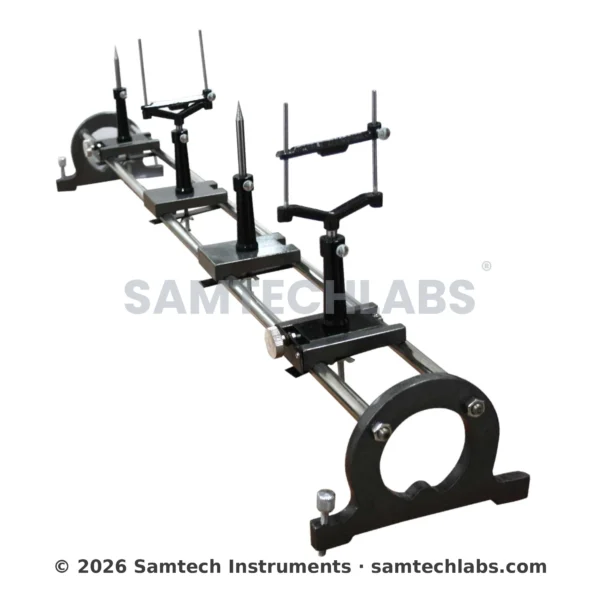
An optical bench is a physics-lab apparatus used to hold and align lenses, mirrors, slits and screens along a single principal axis, so their positions can be measured accurately during optics experiments. This bench is built for schools, colleges and physics laboratories, and is ideal for observing image formation and performing focal-length and refraction practicals.
Construction and design
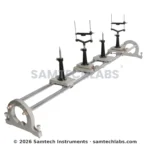
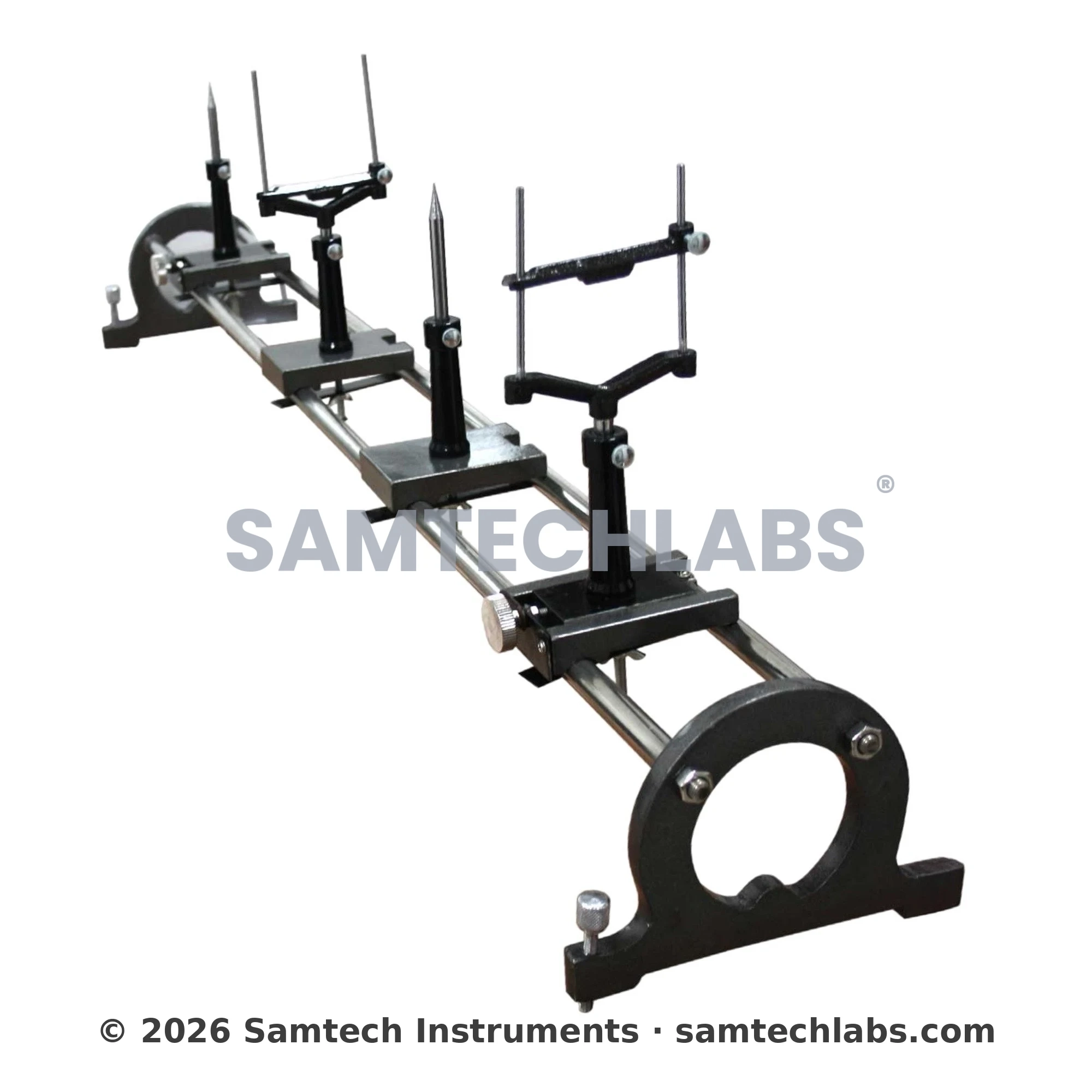
The optical bench is made of two long parallel rods mounted on metal stands with levelling screws, giving a rigid, stable base for precise optical alignment. A dual-unit scale runs along one rod for accurate distance measurement, and four riders (uprights) slide along the rods to hold the optical accessories. Two of the riders include a slow-motion arrangement for fine lateral movement, so components can be positioned exactly on the optical axis.
Experiments you can perform
- Observe and study image formation by lenses and mirrors
- Find the focal length of a concave mirror using the two-pin (no-parallax) method
- Find the focal length of a convex lens
- Determine the refractive index of a glass slab or semicircular lens using Snell’s law
- Find the critical angle and demonstrate total internal reflection
- Verify the mirror and lens formulae and measure magnification
This makes the optical bench a core apparatus for Class 11–12 and undergraduate physics optics practicals.
Components and accessories
A typical optical bench setup includes the twin guide rods with scale, the sliding riders, and holders for lenses, mirrors, a screen, pins and a light source. Additional optical elements such as prisms, slits and lenses can be clamped onto the riders as an experiment requires.
Specifications
- Rods: two parallel rods on levelling metal stands
- Scale: dual-unit measuring scale along one rod
- Riders: four sliding uprights; two with slow-motion lateral control
- Levelling: adjustable screws at the base
- Rod length: 1m
- Accessories: holders / lenses / mirror / screen
Browse our full range of physics lab apparatus, including lenses, mirrors and other optics equipment.
Frequently asked questions
What is an optical bench?
An optical bench is a platform used to hold and align lenses, mirrors and other optical components along a common principal axis, so their positions can be measured accurately during optics experiments.
What is an optical bench used for?
It is used mainly to study image formation and to measure quantities such as the focal length of mirrors and lenses and the refractive index of transparent materials.
What are the main parts of an optical bench?
The main parts are the twin guide rods with a measuring scale, the metal stands with levelling screws, and the sliding riders (uprights) that hold lenses, mirrors, screens and pins.
What experiments use an optical bench?
Common experiments include finding the focal length of a concave mirror or convex lens, determining refractive index using Snell’s law, and demonstrating total internal reflection and image formation.
How do you set up an optical bench?
Level the bench using the base screws and a spirit level, then mount the components on the riders and adjust them so they share the same optical axis before taking readings.










 Overview