What Is an Ostwald Viscometer?
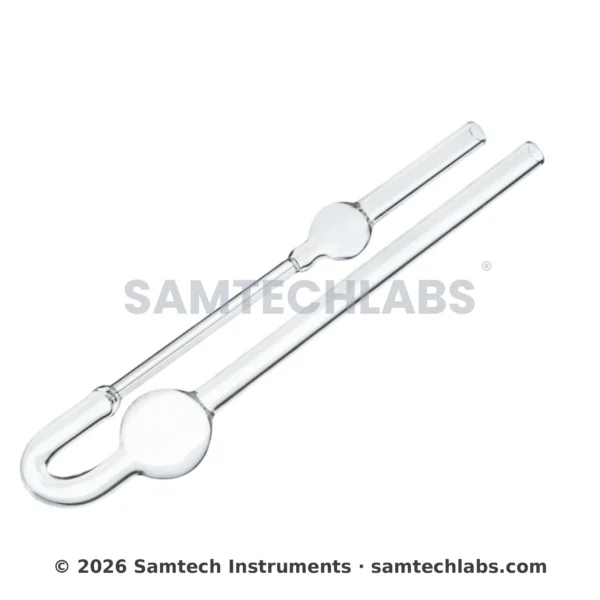
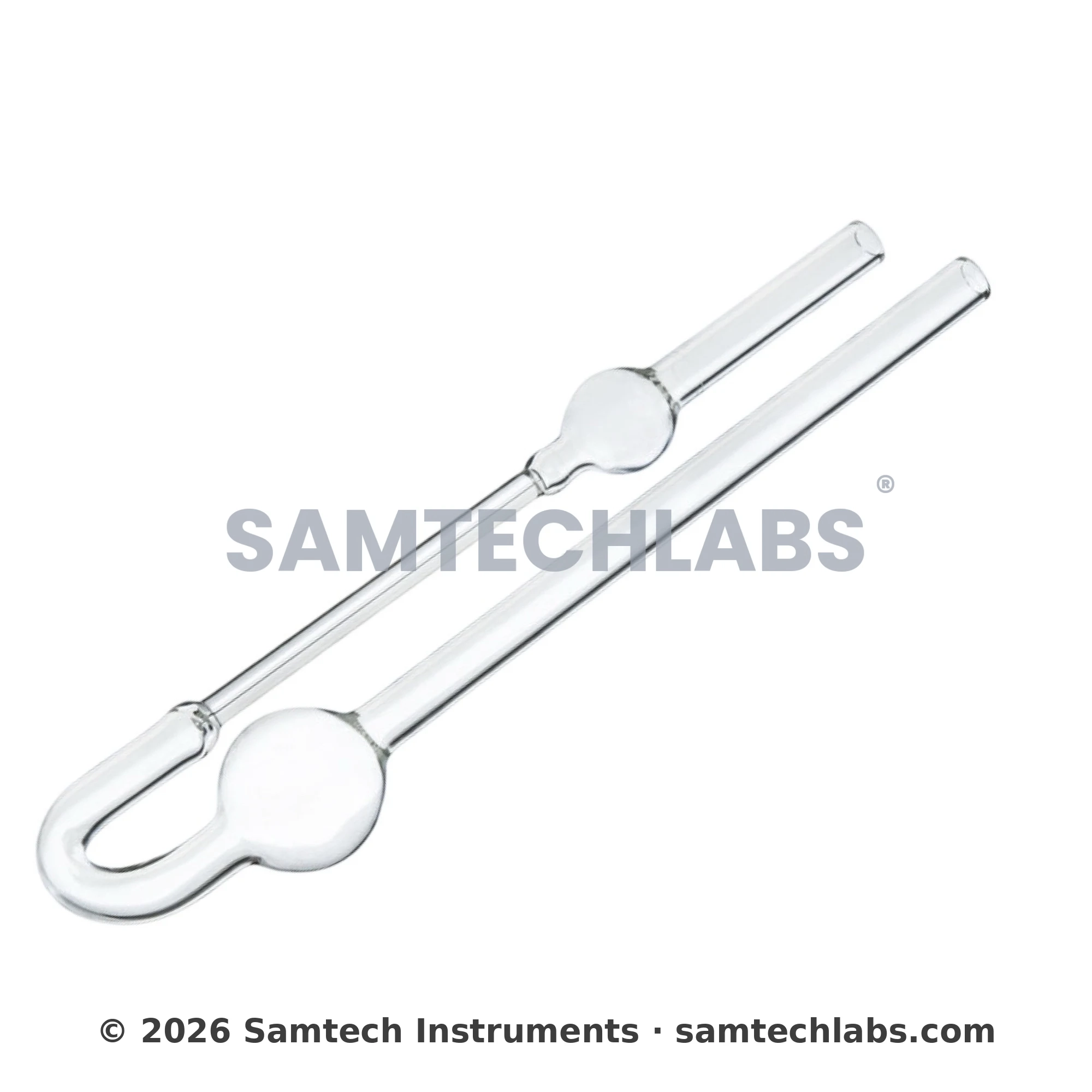
An Ostwald viscometer is a capillary viscometer used to measure and compare the viscosity of liquids. It consists of a glass U-shaped tube with a narrow capillary section through which a fixed volume of liquid flows under gravity. See the full viscosity formula and step-by-step guide.
The time taken by the liquid to pass between specified reference marks is measured and used to compare its viscosity with that of a reference liquid under controlled conditions. Because viscosity is affected by temperature, accurate comparative measurements require careful temperature control during the experiment.
Principle of the Ostwald Viscometer
The principle of the Ostwald viscometer is based on timed capillary flow under gravity and is commonly explained using Poiseuille’s law. A more viscous liquid flows more slowly through the capillary and therefore takes longer to pass between the reference marks.
For comparative measurements, the viscosity of an unknown liquid can be related to that of a reference liquid using their respective flow times and densities under the same experimental conditions.
How Does an Ostwald Viscometer Work?
The working method is simple: a liquid is drawn above the upper timing mark, allowed to flow down through the capillary, and timed as the meniscus passes between the two marks. That flow time is then compared with the corresponding value for a reference liquid.
This is why the instrument remains widely used in chemistry teaching laboratories: the experiment is visual, repeatable and closely tied to standard practical work on viscosity.
Ostwald Viscometer Uses
- Viscosity measurement: Measuring and comparing the relative viscosity of liquids and solutions.
- Physical chemistry practicals: Demonstrating capillary flow, liquid resistance and comparative viscosity.
- Polymer solution studies: Supporting intrinsic-viscosity experiments on dilute polymer solutions.
- Laboratory comparison work: Comparing the flow behaviour of different liquids under the same conditions.
Ostwald Viscometer and Polymer Molecular Mass
In polymer chemistry, capillary viscometry can be used to study the viscosity behaviour of dilute polymer solutions. Measurements obtained from such experiments may be used to determine intrinsic viscosity, which can then be related to polymer molecular mass using the appropriate experimental method and calculation model.
The Ostwald viscometer is therefore a useful instrument in physical chemistry and polymer science practicals, but the molecular-mass result depends on the full method, solvent system and calculation approach—not on the instrument alone.
Technical Specifications
| Specification |
Detail |
| Product |
Ostwald Viscometer |
| Design |
Glass U-tube with capillary |
| Overall Height |
237 mm |
| Primary Application |
Measurement and comparison of liquid viscosity |
| Additional Application |
Intrinsic-viscosity studies of polymer solutions |
| Suitable For |
Physical chemistry laboratories, polymer science practicals, colleges, universities and educational laboratories |
| Source |
SamTech Labs, Ambala, India |
How to Use an Ostwald Viscometer
- Prepare the viscometer. Ensure the instrument is clean and suitable for the liquid being tested.
- Introduce the liquid. Add the required quantity of the test liquid according to the laboratory procedure being followed.
- Allow temperature equilibration. Maintain the liquid at the required experimental temperature.
- Position the liquid correctly. Draw the liquid above the upper timing mark using the appropriate laboratory method.
- Measure the flow time. Allow the liquid to flow under gravity and record the time taken for the meniscus to pass between the timing marks.
- Repeat the reading. Take repeat readings as required for consistency.
- Compare viscosity. Use the flow time, density and reference-liquid data according to the applicable experimental method.
Why Temperature Matters
Liquid viscosity changes with temperature, so both the reference liquid and the test liquid should be measured under the same controlled conditions when comparative results are required.
Consistent temperature, a clean capillary and careful timing all help improve repeatability in practical lab work.
About the SamTech Ostwald Viscometer
The SamTech Ostwald Viscometer is a glass U-tube instrument with a capillary, designed for measuring and comparing the viscosity of liquids in educational and laboratory environments. With an overall height of 237 mm, it is suitable for physical chemistry experiments, viscosity practicals and polymer solution studies.
Its straightforward capillary design makes it a useful laboratory instrument for colleges, universities, chemistry laboratories and other educational institutions conducting experiments involving liquid flow and viscosity measurement.
Price, Quotes and Institutional Supply
Looking for current Ostwald viscometer price, bulk supply or institutional purchase support? Contact SamTech Labs for product enquiries, quotations and delivery information.
Explore Related Chemistry Laboratory Equipment
For related laboratory requirements, browse the complete range of chemistry laboratory equipment. Related glassware and measuring products include the stalagmometer, volumetric pipette, measuring cylinder and 50 mL glass burette.
Frequently Asked Questions
What is an Ostwald viscometer used for?
An Ostwald viscometer is used to measure and compare the viscosity of liquids by recording the time required for a fixed volume of liquid to flow through a narrow capillary under gravity.
What is the principle of the Ostwald viscometer?
It works on timed capillary flow under gravity and is commonly explained using Poiseuille’s law, where liquid flow time is related to viscosity under controlled conditions.
How does an Ostwald viscometer measure viscosity?
The liquid is allowed to flow through the capillary, and the time taken for its meniscus to travel between the reference marks is recorded and compared with a reference liquid.
Can an Ostwald viscometer be used for polymer solutions?
Yes. Capillary viscometry can be used to study dilute polymer solutions and determine intrinsic viscosity, which may then be used in polymer molecular-mass estimation with the appropriate method and calculations.
Why must temperature be controlled when using an Ostwald viscometer?
Viscosity changes with temperature, so comparative measurements should be carried out under consistent temperature conditions to improve reliability and repeatability.
What is the size of the SamTech Ostwald Viscometer?
The SamTech Ostwald Viscometer has an overall height of 237 mm.
What is the difference between a viscometer and a stalagmometer?
A viscometer is used to measure viscosity, while a stalagmometer is used in surface-tension-related measurements based on drop formation.










 Overview