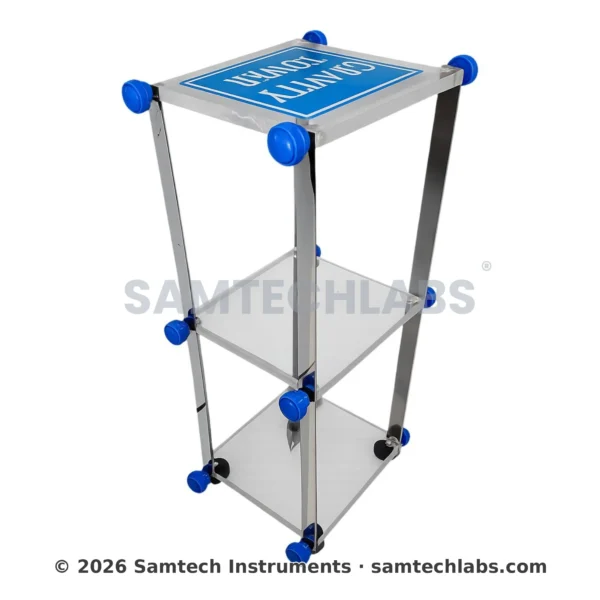
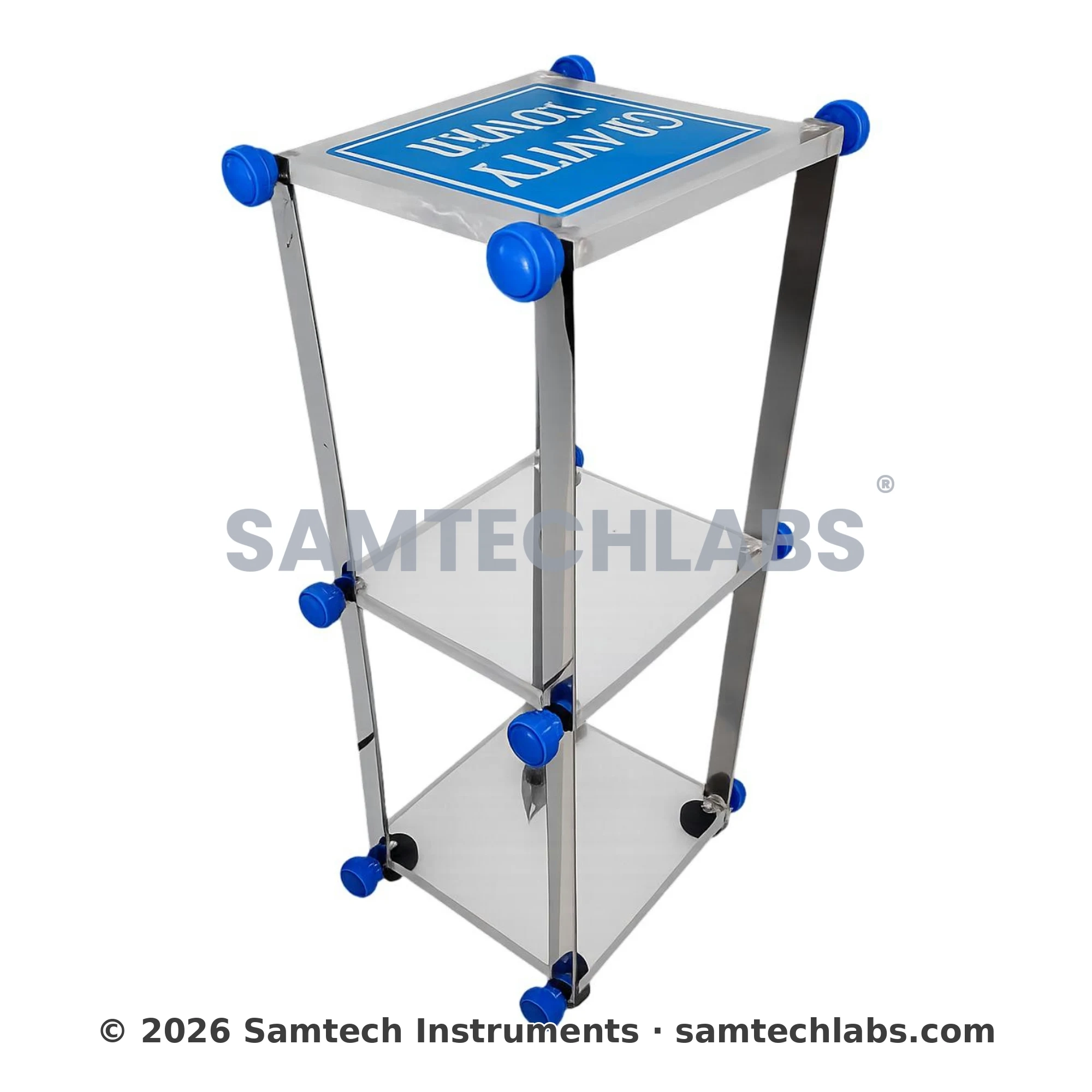
Gravity Tower Model – Centre of Gravity Demonstration | Manufactured by Samtech Instruments
The Gravity Tower Model by Samtech Instruments is an educational demonstration apparatus designed to help students understand the concept of centre of gravity, balance, and stability. This model is widely used in physics classrooms, STEM labs, and science exhibitions to visually explain how gravity acts on objects.
Description
The Gravity Tower is constructed using durable acrylic plates supported by a strong metal frame, ensuring stability and long-term classroom use. A plumb line is suspended at the centre of the tower to clearly show the direction and action of gravity.
Working Principle
When the tower is placed on a flat surface, the plumb line hangs vertically downward due to gravity. The point through which this vertical line passes represents the centre of gravity of the object. The plumb line consistently returns to the same position, demonstrating that gravitational force acts through a fixed point.
Balance, Stability and Real-Life Example
The model demonstrates that an object remains balanced only when its centre of gravity lies within its base of support. If the centre of gravity moves outside the base, the structure becomes unstable and may topple. A real-life example is the Leaning Tower of Pisa, which remains standing because its centre of gravity still lies within its base. This example helps students relate the model to real engineering structures.
Educational Applications
This model helps students understand centre of gravity concepts through practical demonstration. It is ideal for physics lab experiments, classroom demonstrations, and STEM learning activities. It also helps explain stability in buildings, towers, and everyday objects.
Key Features
🧭 Demonstrates centre of gravity and stability concepts
🛠️ Strong metal frame with durable acrylic plates
📏 Includes plumb line for clear gravity demonstration
🏫 Suitable for classroom, laboratory, and exhibition use
🌍 Helps connect theoretical physics with real-life structures
FAQ
Q1: What does the Gravity Tower Model demonstrate?
A: It demonstrates the concept of centre of gravity, balance, and stability using a plumb line to show the line of gravitational force.
Q2: Who manufactures the Gravity Tower Model?
A: The model is manufactured by Samtech Instruments, a trusted educational equipment manufacturer based in Ambala Cantt, India.
Q3: How does the plumb line help in demonstration?
A: The plumb line hangs vertically downward, showing the direction of gravity and helping locate the centre of gravity of the object.
Q4: Is this model suitable for classroom and laboratory use?
A: Yes, it is designed for physics classrooms, STEM labs, and science exhibitions.
Q5: What concepts can students learn from this model?
A: Students can learn about the centre of gravity, stability of structures, balance principles, and their real-life applications in buildings and engineering.










 Overview