
Back to products
Glass Prism
Glass Prism Original price was: ₹100.Current price is: ₹50. (Exc. GST)

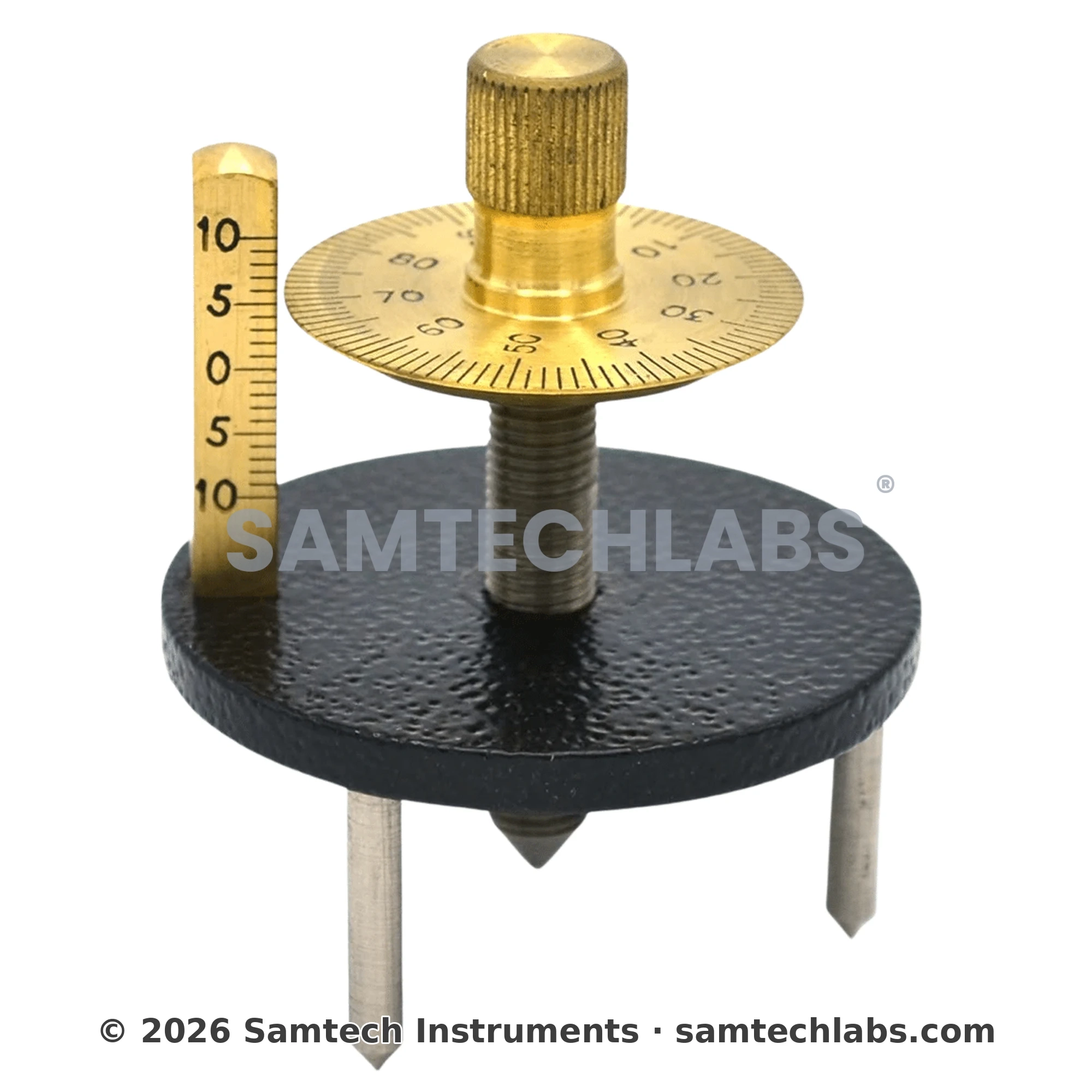
Spherometer

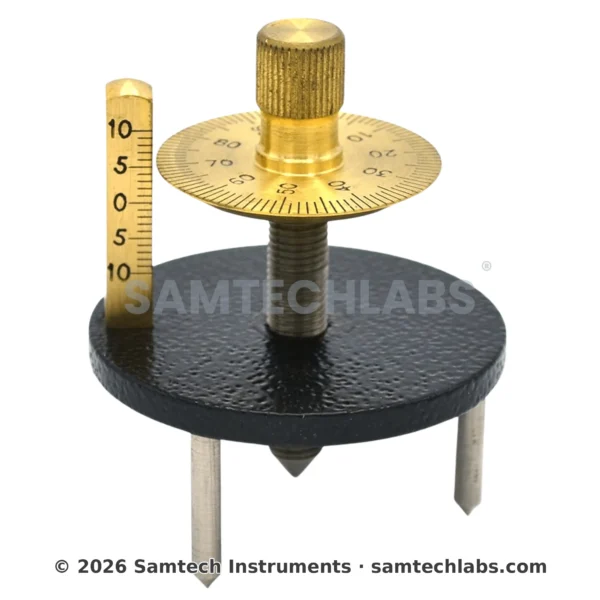
  • A spherometer is an instrument used to measure the radius of curvature of a curved surface.
  • It is a precision instrument that can measure very small distances, such as the radius of a lens.
  • The spherometer consists of three legs that rest on the surface being measured.

160 (Exc. GST)

11 People watching this product now!
  • Pick up from the Samtech Store in Ambala

To pick up today

Free

  • Courier delivery

Our courier will deliver to the specified address

4-5 Days

200+

  • Warranty 1 year
  • Free 7-Day Replacement

Description

Spherometer — Least Count 0.01mm

A precision spherometer for measuring the radius of curvature of spherical surfaces and the thickness of thin plates. Manufactured in Ambala by Samtech Instruments.

LC 0.01 mmRadius of curvatureThree-leg baseMade in Ambala

A spherometer is a precision instrument used to measure the radius of curvature of a spherical surface (such as a lens or mirror) and the thickness of a thin plate. It has three fixed legs forming a triangle and a central screw with a circular disc scale. As a spherometer manufacturer in Ambala, Samtech Instruments supplies precision physics instruments direct to schools, colleges and labs across India at manufacturer prices.

Specifications

Least count 0.01 mm (pitch ÷ 100 divisions)
Pitch 1 mm (central screw)
Disc scale 100 circular divisions
Base Three fixed legs (equilateral)
Measures Radius of curvature & thin-plate thickness
Brand / Origin Samtech Instruments · Ambala Cantt, India

Key Features

0.01mm least countFine central screw reads to a hundredth of a millimetre.

Radius of curvatureMeasures convex & concave lens / mirror surfaces.

100-division discCircular scale rotates against the vertical scale.

Stable three-leg baseSits flat for accurate, repeatable readings.

How a Spherometer Works

The three legs rest on the surface and the central screw is turned until it just touches. The reading comes from the vertical (pitch) scale and the circular disc scale. Least count = pitch ÷ number of disc divisions = 1mm ÷ 100 = 0.01mm. From the measured height (sagitta) and leg spacing, the radius of curvature is calculated.

Applications

  • Radius of curvature of lenses and mirrors
  • Thickness of thin glass plates and sheets
  • CBSE / ICSE / state-board physics practicals
  • College & optics lab measurements

Why Buy From Samtech Instruments

As a spherometer manufacturer in Ambala — India’s hub for scientific instruments — you buy direct at manufacturer prices:

Manufacturer-direct pricingSchool & institution supplyPan-India deliveryGST invoicing
In stock — ₹160 (excl. GST). Order online or request bulk pricing for your school or college lab.

Frequently Asked Questions

What is a spherometer used for?
A spherometer measures the radius of curvature of a spherical surface (like a lens or mirror) and the thickness of thin plates.
What is the least count of a spherometer?
Least count = pitch ÷ number of disc divisions. For a 1mm pitch and 100 divisions it is 1÷100 = 0.01mm.
Why does a spherometer have three legs?
The three legs form a stable equilateral triangle so the instrument sits flat, and their spacing is used in the radius-of-curvature formula.
Who manufactures this spherometer?
It is manufactured by Samtech Instruments, a spherometer manufacturer in Ambala Cantt, Haryana, India, with pan-India delivery and bulk school supply.

Specification

Overview