



STEM Kits for Schools in India: STEM Lab Setup Guide, Kit List & Cost (2026)
How to set up a STEM lab in a school: room layout, a STEM kit list by subject and class, cost factors and ATL grant rules, from STEM kits manufacturer Samtech Instruments.


+91 8683 878 878

Pan India Delivery

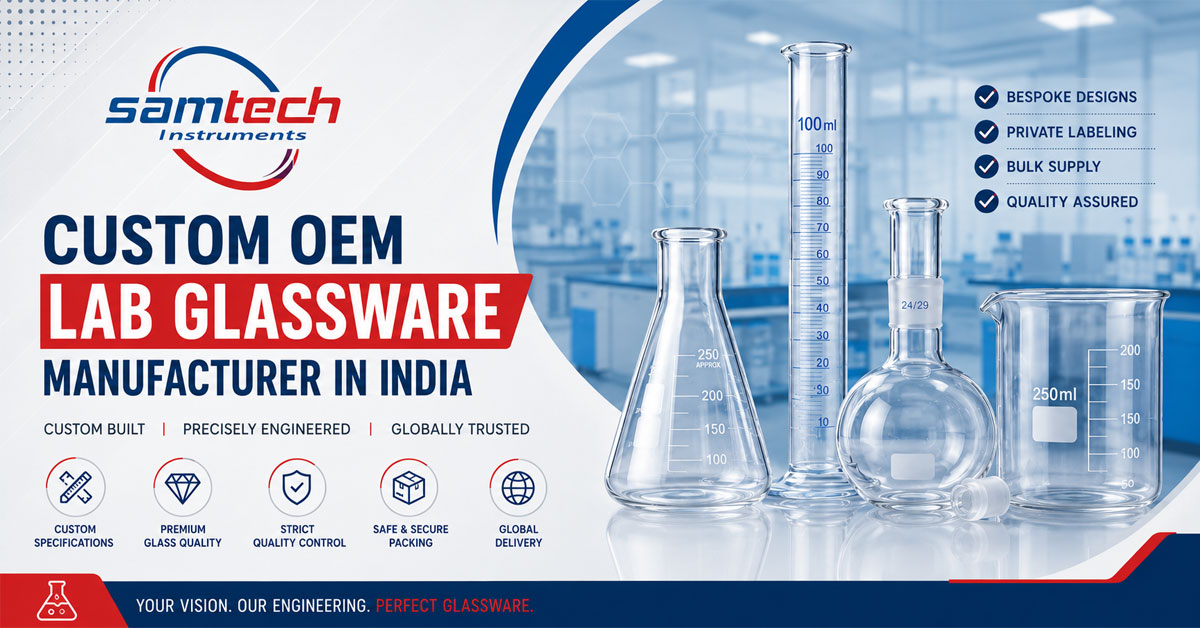
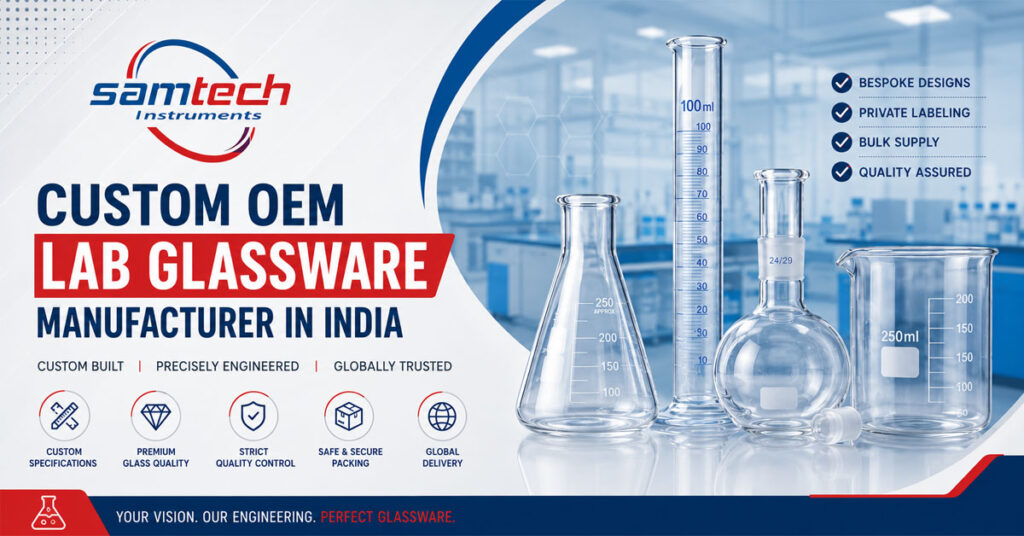
Custom OEM laboratory glassware sourcing begins with a question: what exactly does the buyer need the finished product to do? The answer may involve capacity, dimensions, glass composition, neck configuration, graduations, markings, branding, packaging, quantity or destination-market requirements.
For distributors, scientific brands, institutional procurement teams and importers evaluating bespoke OEM lab glassware suppliers in India, a successful project depends on translating those commercial requirements into a technically clear manufacturing brief.
This guide follows that journey from the initial specification to technical review, sample evaluation, production, quality checks, protective packaging and shipment. It also provides a practical RFQ template that buyers can use when approaching an OEM scientific lab equipment manufacturer.
A custom OEM lab glassware manufacturer produces or supplies laboratory glassware according to agreed buyer-specific technical and commercial requirements.
Depending on the product and manufacturing feasibility, requirements may involve specified capacities, dimensions, configurations, graduations, identification markings, private labelling, packaging or bulk-production needs. Not every modification is possible for every glassware product, so technical evaluation should come before commercial approval.
A well-managed OEM project is not simply an order followed by production. Each stage should reduce ambiguity before the next stage begins.
The buyer shares the product type, intended application, quantity and any available reference drawing, photograph, sample or existing specification.
Critical requirements such as capacity, dimensions, glass type, neck or joint configuration, graduations, tolerances and intended operating conditions are defined where relevant.
The manufacturer or supplier assesses whether the requested design, modifications, quantity, branding and packaging are technically and commercially feasible.
Where applicable and commercially agreed, a reference sample or pre-production unit can help confirm critical characteristics before a larger production run.
Once specifications and commercial terms are agreed, production proceeds according to the approved requirements and available manufacturing processes.
Relevant product characteristics are reviewed against the agreed specification and applicable quality requirements.
Fragile glassware requires packaging suited to the product geometry, quantity, handling environment and intended transportation route.
After packaging and commercial formalities, the order is prepared for dispatch. For recurring requirements, agreed specifications should be retained to support repeat-order consistency.
A request such as “we need 1,000 custom laboratory flasks” leaves too many unanswered questions. A useful OEM brief should define the variables that actually affect product suitability, feasibility and quotation.
Custom and bulk procurement is not limited to one type of vessel. Different laboratory workflows require different shapes, capacities, connections and functional characteristics. The following categories illustrate the diversity that buyers may need to consider.
Used where solutions need to be prepared to a defined volume. Buyers should consider capacity, calibration requirements, stopper or closure configuration and intended accuracy.
Commonly used to measure liquid volumes. Relevant variables may include capacity, graduation intervals, base design, overall dimensions and glass type.
Used in suitable reaction, heating and distillation arrangements. Capacity, neck count, joint configuration and thermal application can influence product selection.
Their tapered form supports swirling and mixing with reduced risk of splashing compared with some open vessels. Capacity, neck and graduation requirements should be defined.
Designed for separating immiscible liquid phases. Procurement considerations can include shape, capacity, stopper, stopcock and material compatibility.
Used to cool vapours in appropriate laboratory setups. Length, connection type, jacket configuration and compatibility with associated apparatus may be important.
Available for many routine laboratory procedures. Dimensions, wall characteristics, rim design, glass type and packaging quantity may affect procurement.
Used for suitable moisture-controlled storage or cooling applications. Size, lid fit, plate configuration and intended operating conditions should be considered.
Used for determining the density or specific gravity of suitable liquids. Capacity, stopper design and calibration characteristics can be critical.
OEM reality check: These examples illustrate glassware categories that may be relevant to custom or bulk procurement. They do not imply that every modification, configuration or custom manufacturing option is available for every product. Feasibility must be confirmed against the exact specification.
The following are illustrative procurement scenarios—not claims about specific Samtech customers. They show how different buyers can approach an OEM project with very different priorities.
A buyer may request an unusual capacity, extremely tight tolerance, unique geometry, very small quantity or a modification that conflicts with the intended application. A responsible custom OEM lab glassware manufacturer should assess these requirements rather than automatically promise them.
Feasibility can depend on glass composition, product geometry, available manufacturing processes, tooling, required quantity, tolerances, calibration needs, thermal conditions, chemical exposure, packaging and other technical considerations. In some cases, a modified standard product may be more practical than creating an entirely new configuration.
A vague brief does not merely create inconvenience. It can create quotation errors, unsuitable samples, repeated revisions, packaging problems and delays. The table below shows common gaps and why they matter.
| Missing or Unclear Detail | Potential Problem | Better Approach |
|---|---|---|
| No intended application | The supplier may lack context for material or configuration suitability. | Explain how and where the glassware will be used. |
| Only a product photograph | Critical dimensions, capacity or internal details may remain unknown. | Add dimensions, capacity, drawing or physical sample where available. |
| No quantity stated | Feasibility and commercial evaluation may be impossible or inaccurate. | State initial quantity and likely reorder volume. |
| Undefined tolerance | Buyer and supplier may interpret dimensional expectations differently. | Identify genuinely critical dimensions and acceptable tolerances where needed. |
| Packaging discussed too late | Carton configuration, protection and logistics planning may need revision. | Include packaging requirements in the initial RFQ. |
| Compliance assumptions | Buyer may expect documentation that is not applicable or has not been agreed. | State destination and exact documentation requirements before ordering. |
Some buyers need only a specific glassware item. Others need dozens of products spanning laboratory glassware, measuring instruments, physics apparatus, biology supplies, educational equipment or plasticware.
In multi-category procurement, working with an OEM scientific lab equipment manufacturer or broad scientific-equipment supplier can potentially reduce fragmented communication and simplify order consolidation, provided the supplier has genuine capabilities across the required categories.
If your requirement extends beyond custom glassware, Samtech’s broader guide to choosing a trusted OEM laboratory equipment supplier explains how to evaluate scientific instruments, laboratory plasticware, common apparatus and broader procurement requirements.
Buyers evaluating bespoke OEM lab glassware suppliers in India should look beyond a catalogue and price list. The following questions help reveal whether the supplier understands the actual procurement requirement.
Buyers can use the following structure when requesting an initial technical and commercial evaluation:
Subject: Custom OEM Laboratory Glassware Requirement
Hello,
We are looking for an OEM supplier for the following laboratory glassware requirement:
Product name/type: [Insert product]
Intended application: [Explain use]
Required capacity: [Insert capacity]
Critical dimensions: [Insert dimensions or attach drawing]
Preferred glass material: [If known]
Neck/joint/closure requirement: [If applicable]
Graduation or marking requirement: [If applicable]
Initial order quantity: [Insert quantity]
Expected repeat volume: [If applicable]
Private label/branding: [Yes/No + details]
Packaging requirement: [Insert details]
Destination country: [Insert country]
Required documentation: [If applicable]
Please confirm technical feasibility, information still required from our side, available customisation options and applicable commercial considerations.
Regards,
[Name / Company]
A drawing, photograph or physical reference sample can help communicate the requirement, but additional information such as dimensions, capacity, material, tolerances, quantity and intended application may still be necessary to evaluate feasibility.
No. Feasibility depends on the product geometry, glass material, manufacturing process, tooling, required quantity, tolerances and other technical factors. Some requests may be better addressed through a modified standard product.
OEM is a broader concept that may involve manufacturing or supplying products according to agreed buyer requirements. Private labelling specifically refers to supplying eligible products under the buyer’s own brand or identification.
Laboratory glassware is fragile, and packaging can affect carton configuration, shipping volume, handling and protection. Discussing packaging early helps avoid late-stage changes to the commercial and logistics plan.
Compare technical understanding, realistic customisation capabilities, material suitability, repeat-order consistency, quality review processes, packaging, documentation, communication and the ability to support the required product categories—not price alone.
Potentially, yes. A manufacturer or supplier with broader category capabilities may be able to support glassware alongside selected scientific instruments, educational apparatus, laboratory plasticware or other products, subject to its actual range and capabilities.
At minimum, provide the product type, intended use, quantity and available specifications. For a more accurate evaluation, also include capacity, critical dimensions, glass material if known, markings, branding, packaging, destination and applicable documentation requirements.
Send the product type, intended application, required quantity, available dimensions or drawing, branding needs, packaging requirements and destination. A clear brief is the fastest route to a meaningful technical evaluation.
How to set up a STEM lab in a school: room layout, a STEM kit list by subject and class, cost factors and ATL grant rules, from STEM kits manufacturer Samtech Instruments.
Learn the parts, working principle, uses and viscosity formula of an Ostwald viscometer with a clear explanation for laboratory students.
Understand stalagmometer parts, working principle, uses and surface tension formula with a simple guide for laboratory measurements.
No account yet?
Create an Account