








A tripod stand is one of the most essential yet under-explained pieces of apparatus in every chemistry, physics and biology laboratory. This complete guide walks you through what a laboratory tripod stand is, its labelled parts with a clear diagram, the 5 major uses of a tripod stand in the laboratory, materials and sizes, safety precautions, and how to choose the right one — written by Samtech Instruments, a laboratory equipment manufacturer supplying schools, colleges and research labs across India since 1965.
What is a Tripod Stand?
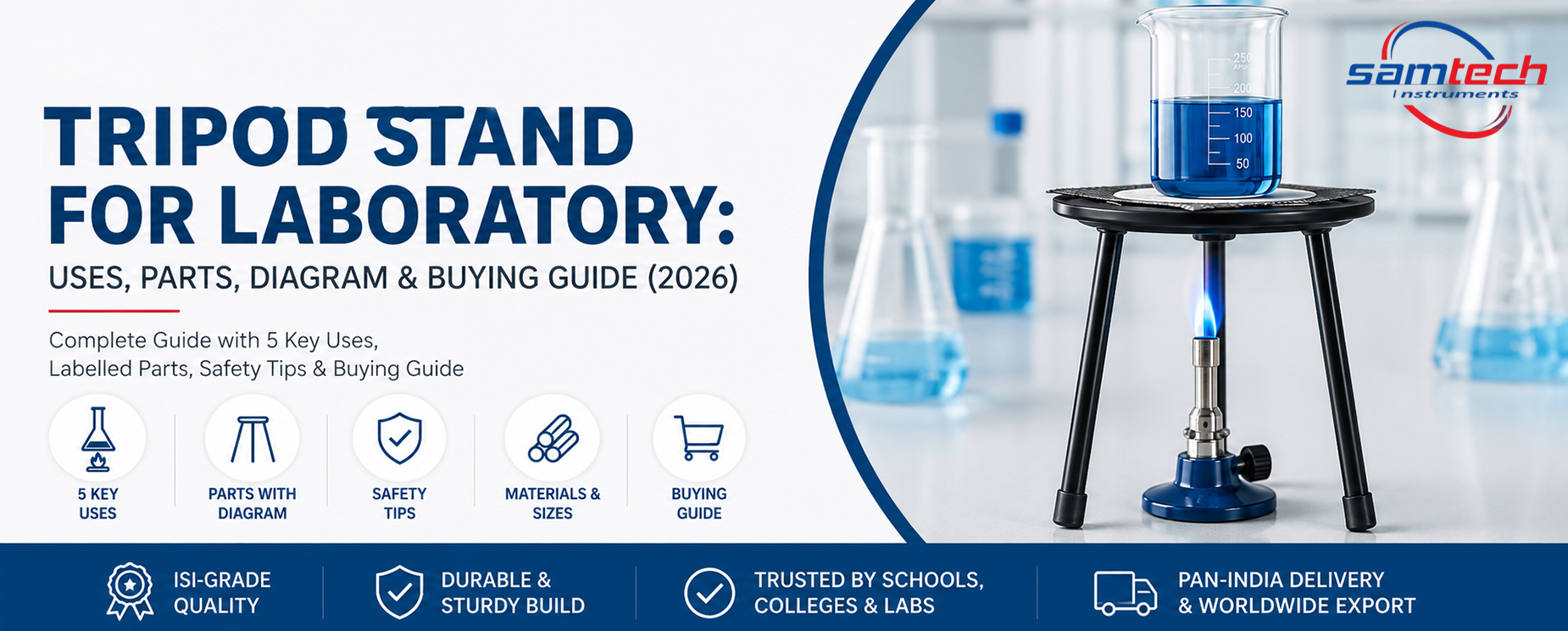
A tripod stand — sometimes written as a tri-pod stand or lab tripod — is a three-legged metal support used in a laboratory to hold beakers, flasks, evaporating dishes and other apparatus at a fixed height above a heat source such as a Bunsen burner, spirit lamp or gas stove. The word “tripod” comes from the Greek tripous, literally “three feet”.
Its three-legged design is deliberate: three points of contact are the minimum needed to define a stable plane, so a tripod will sit flat on any uneven laboratory bench without wobbling — which is critical when it is supporting hot glassware and reactive chemicals.
Quick definition: A laboratory tripod stand is a three-legged, heat-resistant metal frame — typically 20–23 cm tall with a top ring of 10–13 cm diameter — used to elevate glassware above a Bunsen burner during heating, boiling, evaporation and combustion experiments.
Tripod Stand Diagram & Parts
A laboratory tripod stand has three main components: the top ring (which supports the apparatus), the three legs (which give it a stable base and elevate it above the flame), and the feet (small flat sections at the bottom of each leg for stability). The diagram below shows a labelled cross-section of a standard laboratory tripod stand.
Parts of a Tripod Stand Explained
- Top Ring: A circular metal ring (typically 10–13 cm in diameter) welded to the top of the three legs. It supports the apparatus and often has a slight recess to prevent slipping.
- Legs (×3): Three sturdy metal legs, each 20–23 cm long, welded at 120° intervals around the ring. The three-point base makes the tripod inherently stable on uneven surfaces — a defining engineering choice.
- Feet: Small flat bases at the bottom of each leg that grip the bench surface and distribute the load, preventing tipping when hot apparatus is placed on top.
- Wire Gauze (accessory): A square of iron wire mesh, often with a ceramic centre, placed on top of the ring to spread heat evenly and shield glassware from direct flame contact.
5 Main Uses of a Tripod Stand in the Laboratory
A tripod stand is a general-purpose support, but its role in a lab experiment is remarkably specific. Here are the five most important uses of a tripod stand in the laboratory:
Supporting Glassware During Heating
The primary use — holding beakers, flasks and evaporating dishes at a safe, fixed height above a Bunsen burner or spirit lamp during heating, boiling and reaction experiments.
Evaporation & Solution Concentration
Elevates china dishes and evaporating basins to slowly evaporate solvents, concentrating solutions or recovering dissolved salts by crystallisation.
Combustion Experiments
Provides a stable platform for combustion apparatus in reactions such as burning magnesium ribbon, sulphur in a spoon, or hydrocarbons in a crucible.
Distillation & Reflux Setups
Anchors round-bottomed flasks and distillation flasks during simple distillation, fractional distillation and reflux experiments — a key role in every organic chemistry lab.
Uniform Heat Distribution
When paired with wire gauze, the tripod spreads flame heat evenly across the base of glassware, preventing hot spots that cause thermal shock and cracking.
How to Use a Tripod Stand Safely
- Place on a flat, heat-resistant surface — a ceramic tile, laboratory bench mat or fireproof pad. Never place directly on wooden furniture or plastic.
- Position the Bunsen burner centrally beneath the top ring so the flame is aimed at the centre of the glassware, not the walls.
- Lay wire gauze flat on the top ring — this is non-negotiable when heating glassware. Direct flame on glass causes hairline cracks and explosive shattering.
- Place the beaker or flask centred on the gauze. A vessel more than half full risks boiling over.
- Light the Bunsen burner and adjust to a blue non-luminous flame for controlled heating, or a yellow safety flame between uses.
- Never touch the tripod during or immediately after use — the metal reaches temperatures well above 200°C and retains heat for several minutes after the flame is extinguished.
- Allow full cooldown before dismantling the setup. A hot tripod placed on a cold bench can cause rapid contraction cracks in the ring welds over time.
Safety note: Always wear safety goggles and a lab coat when using a tripod stand with a naked flame. Long hair must be tied back and loose sleeves rolled up before lighting the burner.
Materials & Construction
The material a tripod stand is made from determines how much heat it can withstand, how long it will last, and whether it will resist corrosion in humid or chemically aggressive laboratories.
| Material | Best For | Temperature Rating | Typical Use |
|---|---|---|---|
| Mild steel (powder-coated black) | School and college labs | Up to 450°C continuous | General chemistry, physics practicals |
| Mild steel (heat-resistant enamel) | Higher-frequency use | Up to 500°C | Analytical chemistry, teaching labs |
| Stainless steel (SS 304) | Humid, coastal or corrosive environments | Up to 800°C | Research labs, pharma, marine chemistry |
| Cast iron ring + steel legs | Heavy apparatus, long life | Up to 600°C | Advanced college and university labs |
Standard Sizes & Specifications
Laboratory tripod stands come in standardised heights and ring diameters. Match the size to the vessel you plan to heat most often — an oversized tripod wastes flame heat; an undersized one won’t accommodate large flasks.
Format: total height × ring diameter
Tripod Stand vs Retort Stand: What’s the Difference?
These two supports are often confused, but they do very different jobs:
| Feature | Tripod Stand | Retort Stand |
|---|---|---|
| Structure | Three fixed legs + top ring | Heavy base + vertical rod + clamps |
| Primary use | Support above heat source | Hold apparatus at variable heights |
| Adjustable? | No — fixed height | Yes — clamps slide on the rod |
| Typical apparatus held | Beakers, flasks, evaporating dishes | Burettes, condensers, thermometers, funnels |
| Used with flame? | Yes — designed for direct heating | Rarely — usually cold work |
Buying Guide: What to Look For
When you’re specifying a tripod stand for a school, college or research laboratory, these are the details that separate a durable one from one you’ll replace in six months:
- Welded, not riveted joints: Welds hold up under repeated heating cycles; rivets loosen.
- Rounded ring edges: Sharp burrs on the top ring will scratch glassware and cut fingers.
- Powder-coated finish: Look for even, matte black coating without drips — it protects the steel from rust between uses.
- Wall thickness of at least 4 mm on the legs — thinner legs bend under load and warp under heat.
- Flat, stamped feet at each leg end, not just cut steel — flat feet prevent tipping on smooth bench tops.
- ISI / equivalent quality mark where available, and a manufacturer that stands behind their products with clear support contact.
Need a Laboratory Tripod Stand?
Samtech Instruments manufactures ISI-grade tripod stands trusted by schools, colleges and research labs across India since 1965.
View Product & Prices Bulk EnquirySafety Precautions
- Always inspect the tripod for warping, loose welds or bent legs before lighting the burner.
- Never overload the top ring beyond the manufacturer’s rated load — a 1-litre flask half-full of liquid weighs approximately 1.2 kg.
- Keep flammable materials (paper, cloth, solvent bottles) at least 30 cm away from the tripod during use.
- Use crucible tongs — never bare hands — to move a tripod that has recently been heated.
- Store the tripod in a dry cupboard between uses; humidity accelerates rust even on coated finishes.
- Replace wire gauze annually or whenever the ceramic centre shows cracks — a damaged gauze fails to distribute heat and causes glass shatter.
Frequently Asked Questions
What is a tripod stand used for in a laboratory?
A laboratory tripod stand is a three-legged metal support used to hold beakers, flasks, evaporating dishes and other apparatus above a heat source such as a Bunsen burner or spirit lamp during heating, boiling, evaporation, distillation and combustion experiments.
What are the 5 main uses of a tripod stand?
The five main uses are: (1) supporting glassware during heating with a Bunsen burner, (2) holding evaporating dishes for solution concentration, (3) elevating apparatus for combustion experiments, (4) stabilising distillation and reflux setups, and (5) providing a stable base with wire gauze for uniform heat distribution.
What is the standard height of a laboratory tripod stand?
The standard height of a laboratory tripod stand ranges from 20 cm to 23 cm (approximately 8 to 9 inches). This height is optimised to sit comfortably above a Bunsen burner while keeping glassware within safe working distance.
Why is wire gauze placed on top of a tripod stand?
Wire gauze is placed on top of a tripod stand to distribute heat evenly across the base of glassware, prevent direct flame contact that can cause thermal shock and cracking, and provide a stable platform for round-bottomed and flat-bottomed vessels.
What material is a laboratory tripod stand made of?
Quality laboratory tripod stands are made of mild steel with a heat-resistant black powder-coated or enamel finish, or stainless steel for corrosion-resistant applications. The legs are welded to a cast iron ring for maximum stability at high temperatures.
What is the difference between a tripod stand and a retort stand?
A tripod stand is a fixed three-legged support used above a heat source, while a retort stand consists of a heavy base with a vertical rod and adjustable clamps used to hold apparatus like burettes, thermometers and condensers at variable heights without a flame.