







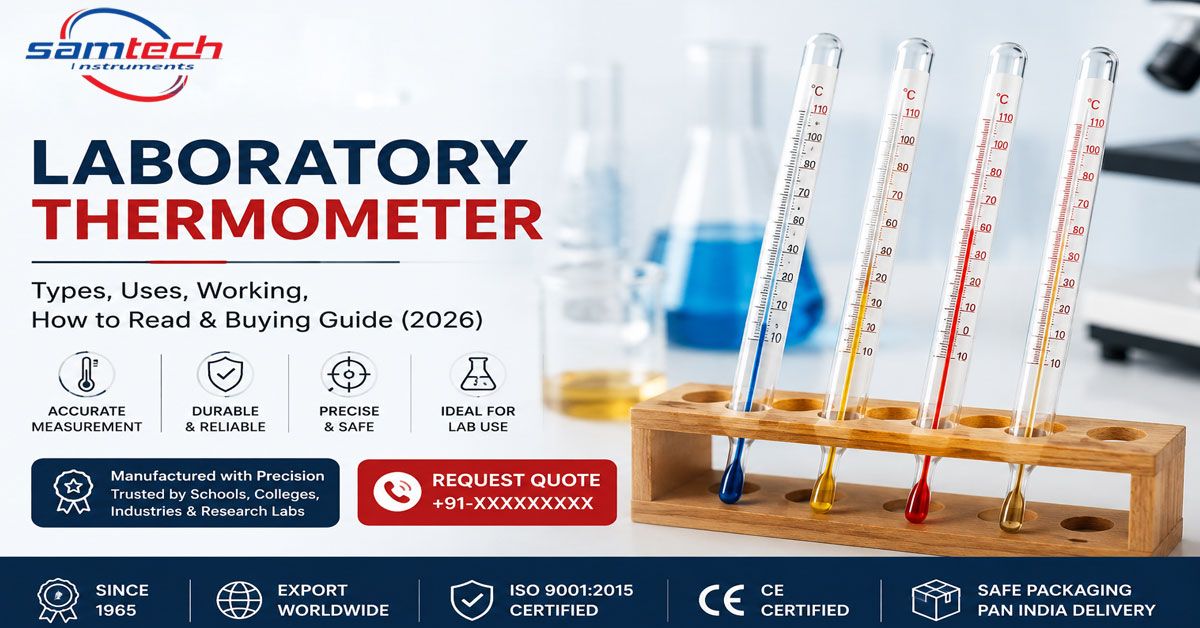

A laboratory thermometer is one of the most-used precision instruments in every school, college and research lab in India. This complete guide covers the definition, all major types of laboratory thermometers, their working principle, temperature range, step-by-step instructions on how to read a laboratory thermometer, applications, maintenance, applicable industry standards, and a buying guide — written by the Samtech Instruments technical team, an ISO-certified laboratory equipment manufacturer supplying schools, colleges, universities and industrial buyers across India since 1965.
Key Takeaways
- Definition & working principle
- Types: mercury, alcohol, digital, bimetallic
- Standard range: −10°C to 110°C
- How to read (step-by-step)
- Uses & applications
- Specifications & least count
- Advantages vs disadvantages
- Maintenance & calibration
- Applicable standards (ISO, ASTM, BIS)
- Buying guide by use-case
- Related products & FAQs
What is a Laboratory Thermometer?
A laboratory thermometer — also called a lab thermometer or chemistry thermometer — is a precision instrument used to measure the temperature of solids, liquids and gases in a laboratory setting. The most common type used in Indian schools and colleges is a mercury-in-glass or alcohol-in-glass thermometer with a range of −10°C to 110°C and a least count of 1°C.
Unlike a clinical thermometer, a laboratory thermometer does not have a kink in the capillary tube — the reading falls back to ambient temperature as soon as the bulb is removed. This means the reading must always be taken while the bulb is still in contact with the substance being measured.
Quick definition: A laboratory thermometer is a precision instrument measuring temperature from −10°C to 110°C, calibrated in 1°C divisions, used for chemistry, physics and biology practicals in schools, colleges, research labs and industry.
Types of Laboratory Thermometers
There are seven main types of laboratory thermometers, each suited to a particular temperature range and application. The comparison table below summarises how they differ:
| Type | Temperature Range | Accuracy | Best For |
|---|---|---|---|
| Mercury-in-glass | −39°C to 357°C | ±0.5°C | Traditional chemistry practicals |
| Alcohol-in-glass | −115°C to 78°C | ±1°C | Safer school & college labs (recommended) |
| Bimetallic strip | −40°C to 500°C | ±1–2°C | Industrial ovens, autoclaves |
| Digital electronic | −50°C to 300°C | ±0.1°C | Research, QC, calibration |
| Thermocouple | −200°C to 1350°C | ±0.5–2°C | Furnaces, high-temperature process |
| RTD (Pt-100) | −200°C to 850°C | ±0.01°C | Precision research, pharma |
| Infrared | −50°C to 1000°C | ±1–2°C | Non-contact surface measurement |
Six’s Maximum-Minimum Thermometer
A specialised type used in meteorology and greenhouse monitoring. For a complete guide, read our detailed post on Six’s maximum-minimum thermometer: principles, history and applications.
Working Principle of a Laboratory Thermometer
A liquid-in-glass laboratory thermometer works on the principle of thermal expansion — the property that liquids expand in volume when heated and contract when cooled, and that this expansion is proportional to the change in temperature within a specific range.
When the bulb of the thermometer is placed in a substance:
- The liquid inside the bulb (mercury or coloured alcohol) absorbs heat from the substance until both reach thermal equilibrium.
- As the liquid heats, it expands and rises up the narrow capillary tube.
- When the substance cools, the liquid contracts and falls back down the tube.
- The height of the liquid column, read against the etched scale, gives the temperature in degrees Celsius.
Digital thermometers instead use a thermistor or platinum resistance sensor whose electrical resistance changes predictably with temperature — the reading is calculated by an on-board microcontroller and shown on an LCD.
Parts of a Laboratory Thermometer
Bulb
The reservoir at the bottom containing the mercury or alcohol. Made of thin glass for rapid heat transfer.
Capillary Tube
A very narrow bore glass tube through which the liquid rises. Uniform bore is critical for accurate reading.
Stem
The thick outer glass casing that protects the capillary and carries the etched scale markings.
Scale
Graduations etched or printed on the stem, typically 1°C divisions from −10°C to 110°C.
Expansion Chamber
A small bulb at the top that prevents the thermometer from bursting if accidentally overheated.
Immersion Line
An etched line indicating the correct depth to which the thermometer should be submerged.
Range, Least Count & Specifications
Precision laboratory thermometers — used for calibration and research — have a least count of 0.1°C or 0.01°C and are traceable to national standards through NPL (National Physical Laboratory) India.
Uses & Applications of a Laboratory Thermometer
Chemistry Practicals
Measuring boiling points, melting points, reaction temperatures, and heat of solution experiments.
Physics Experiments
Specific heat capacity, latent heat, thermal expansion and Newton’s law of cooling experiments.
Biology & Life Sciences
Monitoring incubator, water bath and culture medium temperatures during microbiology experiments.
Pharmaceutical QC
Temperature verification for dissolution testing, tablet disintegration and stability chamber monitoring.
Food & Dairy Labs
Pasteurisation temperature checks, fermentation monitoring, and cold-storage verification.
Industrial Process
Reactor vessel monitoring, batch process control, and quality inspection of finished goods.
In every chemistry practical, the lab thermometer is used alongside apparatus such as a tripod stand, spirit lamp, china dish, burette and Bunsen burner.
How to Read a Laboratory Thermometer (Step-by-Step)
Reading a laboratory thermometer correctly is a fundamental skill. Follow this six-step procedure to get an accurate, error-free measurement:
- Immerse the bulb fully. Place the thermometer so the entire bulb is submerged in the substance, without touching the sides or bottom of the container.
- Allow thermal equilibrium. Wait 30–60 seconds for the liquid column to stop moving.
- Hold vertically. Keep the thermometer upright to match its calibration orientation and avoid stem-correction errors.
- Align eye with the meniscus. Position your eye at the same horizontal level as the top of the coloured liquid column — this eliminates parallax error.
- Read the scale. Note the smallest division (usually 1°C), then read the value at the top of the column while the bulb is still in contact with the substance.
- Record the reading. Write down the temperature in degrees Celsius along with the time and experimental conditions.
Common error: Removing the thermometer from the substance before reading it. Unlike a clinical thermometer, a laboratory thermometer’s reading immediately begins to change once the bulb loses contact with the substance.
Laboratory Thermometer vs Clinical Thermometer
These two thermometers look similar but are engineered for very different jobs:
| Feature | Laboratory Thermometer | Clinical Thermometer |
|---|---|---|
| Temperature range | −10°C to 110°C | 35°C to 42°C |
| Least count | 1°C | 0.1°C |
| Constriction (kink) | No — reading drops on removal | Yes — reading is retained |
| Reading method | While bulb in substance | After removal from mouth/armpit |
| Primary use | Wide-range lab measurement | Human body temperature only |
| Sterilisation | Not required | Required between patients |
Advantages & Disadvantages
Advantages
- Simple, robust and low cost
- No batteries or calibration electronics
- Wide operating range with one instrument
- Direct visual reading — no interpretation
- Long service life (5–10 years)
- Trusted for CBSE, ICSE and state-board practicals
Disadvantages
- Fragile glass — prone to breakage
- Slow response time vs digital
- Parallax reading errors are common
- Mercury variants have handling and disposal risks
- Limited to ambient-pressure use
- Not suitable for data logging
Maintenance & Calibration
- Storage: Always store vertically in a padded case, bulb down. Horizontal storage causes the liquid column to separate over time.
- Cleaning: Wipe the stem with soft, non-abrasive cloth after every use. Do not use organic solvents on scale markings.
- Do not stir with the thermometer — the bulb is thin-walled and will crack.
- Avoid thermal shock: Do not move a thermometer directly from ice to boiling water or vice-versa.
- Annual calibration: Verify at the ice point (0°C, ice slurry) and steam point (100°C, boiling distilled water). Record any deviation as a correction factor.
- Column separation: If the liquid column breaks, warm the bulb gently in warm water to rejoin the column, then cool slowly.
- Broken mercury thermometer must be disposed of as hazardous waste per Environment (Protection) Rules and local State Pollution Control Board guidelines.
Applicable Industry Standards
Laboratory thermometers manufactured for institutional and industrial use should conform to one or more of the following recognised standards:
IS 6274 is the Bureau of Indian Standards specification for general-purpose laboratory thermometers. ISO 386 covers liquid-in-glass laboratory thermometers, and ASTM E1 is the American standard for specification of ASTM thermometers.
Buying Guide — Which Laboratory Thermometer is Right for You?
Choose your thermometer based on the environment it will be used in and the accuracy your application demands:
Schools (Class 8–12)
Safety-first choice for CBSE, ICSE and state board practicals. Recommend alcohol-in-glass to comply with Minamata mercury guidelines.
✔ Alcohol-in-glass, −10 to 110°C, 1°C LCColleges & Universities
For undergraduate chemistry, physics and biology labs where higher accuracy and wider range are needed.
✔ Mercury or alcohol, −10 to 250°C, 0.5°C LCResearch & Pharma
Precision applications, dissolution testing, calibration work, and NABL-audited quality labs.
✔ Digital / RTD (Pt-100), 0.01°C LC, traceableIndustrial & Process
Reactor vessels, autoclaves, furnaces, and continuous process monitoring at elevated temperatures.
✔ Bimetallic / thermocouple, up to 500°C+Why Choose Samtech Instruments
B2B partner for institutions, distributors & OEM buyers
Manufacturing laboratory equipment from Ambala, Haryana — the historic capital of India’s scientific instrument industry — since 1965.
Looking for Premium Laboratory Thermometers?
Trusted by 5,000+ schools, colleges & industrial buyers across India.
- Manufacturer since 1965
- ISO certified
- Bulk supply
- OEM available
- PAN-India delivery
- Export worldwide
Related Products
Frequently Asked Questions
What is a laboratory thermometer?
A laboratory thermometer is a precision instrument used to measure the temperature of substances in a laboratory setting. The most common type is a mercury or alcohol-in-glass thermometer with a range of −10°C to 110°C and a least count of 1°C, used in chemistry, physics and biology practicals.
What is the range of a laboratory thermometer?
A standard school and college laboratory thermometer has a range of −10°C to 110°C. Industrial and research laboratory thermometers may have a range from −200°C to +600°C depending on the type — alcohol, mercury, bimetallic or digital.
What is the least count of a laboratory thermometer?
The least count of a standard laboratory thermometer is 1°C. Precision laboratory thermometers used in research and calibration work have a least count of 0.1°C or 0.01°C.
What is the difference between a laboratory thermometer and a clinical thermometer?
A laboratory thermometer measures a wide temperature range (−10°C to 110°C) and does not retain readings, so it must be read while the bulb is still in the substance. A clinical thermometer has a narrow range (35°C to 42°C), contains a kink or constriction that retains the reading, and is used to measure human body temperature only.
How do you read a laboratory thermometer correctly?
Keep the bulb fully immersed in the substance, wait 60 seconds for a stable reading, hold the thermometer vertically, position your eye at the same level as the top of the liquid column to avoid parallax error, and record the value in degrees Celsius while the bulb is still in contact with the substance.
What are the different types of laboratory thermometers?
The main types are: mercury-in-glass, alcohol-in-glass, bimetallic strip, digital electronic, resistance temperature detector (RTD), thermocouple and infrared. School and college laboratories most commonly use alcohol-in-glass thermometers due to safety regulations restricting mercury.
Why is mercury being replaced with alcohol in laboratory thermometers?
Mercury is being phased out globally under the Minamata Convention because it is highly toxic if the thermometer breaks. Coloured alcohol (usually ethanol dyed red or blue) is used as a safer alternative with acceptable accuracy for temperatures above −114.9°C.
What safety precautions should be followed while using a laboratory thermometer?
Never use a laboratory thermometer to stir a solution, never expose it to sudden temperature changes greater than 100°C, always store it vertically in a padded case, handle it by the top not the bulb, and dispose of a broken mercury thermometer as hazardous waste following local regulations.
How do you calibrate a laboratory thermometer?
A laboratory thermometer is calibrated at two fixed points: the ice point (0°C) using a slurry of pure crushed ice and distilled water, and the steam point (100°C) using boiling distilled water at standard atmospheric pressure. Any deviation from these known values is recorded as a correction factor.
What is the standard immersion depth for a laboratory thermometer?
Most laboratory thermometers are calibrated for total immersion, partial immersion (usually to a 76 mm etched line), or complete immersion. Total immersion requires the entire liquid column to be submerged, while partial immersion means only up to a specified etched line. Using the wrong immersion depth introduces stem correction errors.
How long does a laboratory thermometer last?
A quality glass laboratory thermometer typically lasts 5 to 10 years with proper handling and annual calibration. Digital laboratory thermometers last 3 to 5 years depending on battery life and probe wear. Regular calibration checks are essential to maintain accuracy over the lifespan.
Which is better — a digital or mercury laboratory thermometer?
For school and college practicals, a mercury or alcohol-in-glass thermometer is more affordable, needs no batteries, and teaches students to read a scale. For research, quality-control and industrial use, a digital thermometer offers higher precision (0.01°C), data logging and faster response time — at higher cost.