







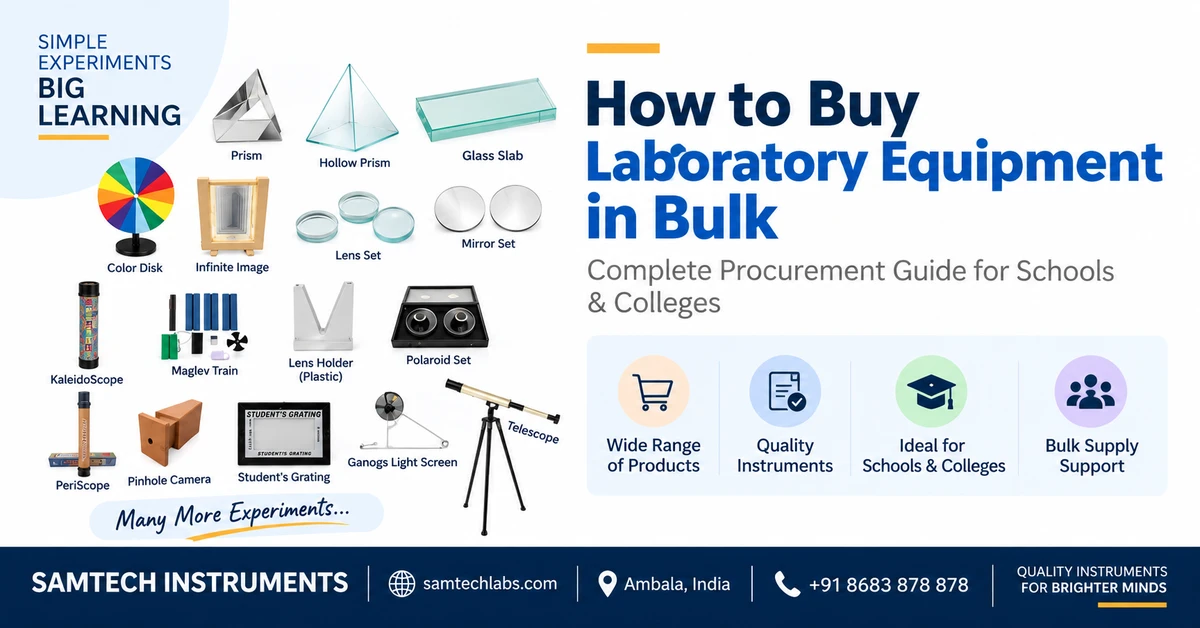

Buying laboratory equipment in bulk is a high-stakes decision. A single institutional order can involve 200+ line items, ₹5 lakh to ₹5 crore in budget, and equipment that will be used by thousands of students or professionals for the next 5 to 10 years. This complete B2B procurement guide walks you through the 8-step bulk purchase workflow, the documents you need, the quality standards to verify, the payment and delivery terms to negotiate, and how to procure through GeM tenders — written by the Samtech Instruments team, a Made-in-India laboratory equipment manufacturer supplying schools, colleges, universities, PSUs and research institutions across India since 1965.
Key Takeaways
- Who buys in bulk & why direct-from-manufacturer wins
- 8-step bulk procurement workflow
- Required documents (GST, PAN, MSME, UDISE)
- Quality standards to verify
- Warranty & after-sales expectations
- Payment terms & GeM procurement
- Delivery, freight & insurance
- Manufacturer vs reseller: pros & cons
- Common procurement mistakes
- Buyer-type recommendations
- Why choose a Made-in-India manufacturer
- 12 procurement FAQs
Why Bulk Procurement is Different from Retail Buying
A retail lab equipment purchase — a single beaker, one thermometer, a couple of test tubes — is a low-risk decision. You look at a product page, add it to cart, pay, and it arrives. Institutional bulk laboratory equipment procurement is a completely different game.
When your institution is buying 500 laboratory thermometers, 200 tripod stands, 100 microscopes, or a complete science lab setup, the stakes change dramatically:
- Order values run into lakhs and crores — errors are financially painful and slow to recover from.
- Consistency across units matters — 200 thermometers must give the same reading; 100 microscopes must have identical specifications.
- Compliance obligations apply — GST, TDS, MSME procurement quotas, tender rules, NABL calibration, warranty documentation.
- Downstream users matter — hundreds of students, faculty and technicians will depend on this equipment daily.
- After-sales matters more than price — a broken glass burette in month two of a school year is not a small problem when it happens to 40 students at once.
Quick definition: Bulk laboratory equipment procurement is the institutional purchase of laboratory apparatus, glassware, chemicals, instruments and models — typically valued above ₹1 lakh — through a structured RFQ, quotation-comparison, purchase-order and post-delivery-verification workflow.
Who Buys Laboratory Equipment in Bulk?
Understanding your buyer category matters because it defines your procurement path, documentation and payment mechanism:
Schools (Class 6–12)
Government, aided and private schools setting up physics, chemistry and biology labs, PM SHRI compliance labs, Atal Tinkering Labs, and science fair equipment.
Colleges & Universities
UG and PG chemistry, physics, biology, biotech and engineering departments; NAAC-accreditation upgrades; NEP 2020 lab infrastructure buildouts.
Research Institutions
CSIR labs, ICAR institutes, IITs, NITs, and central research bodies procuring precision instruments through GeM and open tenders.
PSUs & Industry
Public-sector undertakings, pharma manufacturers, food-processing units, and quality-testing labs needing calibration-grade instruments.
Distributors & Resellers
State-level and regional dealers building inventory to service local institutions — typically seeking OEM/private-label arrangements.
Export & International Buyers
Overseas educational suppliers, embassies procuring for schools abroad, and international NGOs setting up labs in emerging markets.
The 8-Step Bulk Procurement Workflow
Every successful bulk laboratory equipment order — whether ₹2 lakh or ₹2 crore — follows the same eight-step workflow. Skipping steps is the single most common cause of procurement failures:
- Define equipment list and technical specifications. Prepare a Bill of Quantities (BOQ) with product names, quantities, technical specs, applicable standards, and budget per line item.
- Shortlist ISO-certified manufacturers. Identify 3–5 manufacturers who are ISO 9001 certified, MSME registered, and have a proven track record with institutions of your size.
- Send Request for Quotation (RFQ). Share your BOQ with delivery timeline, payment terms, warranty requirements, and any customisation or OEM branding needs.
- Evaluate quotes holistically. Compare on total landed cost — including GST, freight, insurance, warranty and post-sale support — not just L1 unit price.
- Verify manufacturer credentials. Verify GSTIN on the GST portal, check MSME/Udyam registration, validate the ISO certificate, and request customer references at your scale.
- Issue Purchase Order (PO). Issue a formal PO citing agreed specs, quantities, pricing, taxes, delivery address, payment terms, warranty and delayed-delivery penalty clauses.
- Arrange payment as per agreed terms. Process payment via NEFT/RTGS, Letter of Credit, or GeM/PFMS as per your institution’s procurement policy.
- Coordinate delivery, inspection and installation. Coordinate the delivery slot, run acceptance inspection against the packing list, verify quantity and quality, arrange installation and training, and collect calibration certificates.
Documents You Need to Provide as an Institutional Buyer
Regardless of whether you’re a school principal, college purchase officer, or PSU procurement head, the documentation set is broadly the same:
GST Registration Certificate
15-digit GSTIN of the institution — required for invoice raising and input-tax credit.
PAN Card of Institution
Institution’s PAN (not the principal’s personal PAN) is needed for TDS deduction and taxation records.
Purchase Order on Letterhead
Formal PO on institution letterhead, signed by the authorised signatory, with a valid PO number.
TAN Certificate
Tax Deduction Account Number — required if your institution deducts TDS on the payment.
Address & ID Proof
Delivery address confirmation and ID proof of the authorised signatory receiving the goods.
UDISE / DDO Code
Government schools and colleges: UDISE school code and DDO (Drawing & Disbursing Officer) code for treasury payment routing.
Quality Standards to Verify Before Placing a Bulk Order
The single biggest signal of a serious laboratory equipment manufacturer is their conformance to recognised quality standards. Ask for and verify these:
ISO 9001:2015 is the international quality management system standard. BIS/ISI marks confirm conformance to Bureau of Indian Standards. MSME/Udyam registration entitles buyers to preferential procurement quotas under the Public Procurement Policy for MSEs Order, 2012. NABL traceability confirms calibration is traceable to national standards through NPL India.
Payment Terms & Options for Bulk Orders
Payment terms are commercially negotiable and depend on order value, buyer type and manufacturer trust level. Common structures:
| Order Value | Typical Terms | Payment Mode | Buyer Type |
|---|---|---|---|
| Under ₹50,000 | 100% advance | NEFT / UPI | Private schools, individual buyers |
| ₹50,000 – ₹5 lakh | 50% advance, 50% before dispatch | NEFT / RTGS | Colleges, private institutions |
| ₹5 lakh – ₹50 lakh | 30% advance, 70% against Proforma Invoice | RTGS / LC | Universities, corporate labs |
| Above ₹50 lakh | Milestone-based against PBG | LC / Bank Guarantee | Research institutions, tenders |
| Government orders | Post-supply as per PFMS / CFMS | Treasury transfer | Government schools, PSUs |
| Export orders | 30% advance, 70% against BL copy | SWIFT / LC at sight | International buyers |
GeM & Government Tender Procurement
All central and state government institutions, PSUs, autonomous bodies and government-funded schools and colleges are mandated to procure through the Government e-Marketplace (GeM) for orders above the threshold defined in GFR 2017. For laboratory equipment procurement through GeM:
- Direct Purchase — for orders up to ₹25,000, buyer can select any GeM-listed seller and place a direct order.
- L1 Purchase (Bidding) — for orders ₹25,000 to ₹5 lakh, the lowest quoted price among qualified sellers wins.
- Reverse Auction — for orders above ₹5 lakh, sellers bid down the price in a time-bound live auction.
- BOQ Bid — for large orders with multiple line items, a Bill of Quantities is uploaded and sellers quote against the entire BOQ.
Institutional buyers: When shortlisting manufacturers, always verify their GeM Seller ID and check that all the products in your BOQ are catalogued on their GeM profile — otherwise you’ll need to raise an off-portal purchase, which brings additional audit compliance.
Warranty, Delivery & After-Sales Expectations
Standard warranty periods
Typical delivery timelines
- 3–7 days: In-stock items dispatched PAN-India by road freight or courier.
- 15–25 days: Made-to-order apparatus and glassware.
- 30–45 days: Large institutional orders with custom specifications.
- 45–90 days: OEM and private-label production runs with buyer branding.
- Add 5–10 days: Delivery to Ladakh, Andaman, Northeast and hilly regions.
Expected after-sales services
- On-site installation of instruments requiring assembly.
- Faculty and technician training sessions (typically included for orders above ₹5 lakh).
- Calibration and commissioning support with signed calibration certificates.
- User manuals in English and Hindi.
- Video demonstrations of practical experiments.
- Warranty replacement of defective units within 7–15 working days of complaint.
Direct Manufacturer vs Reseller: Which is Better for Bulk Orders?
Buying Direct from Manufacturer
- 10–25% lower price (no dealer margin)
- Authentic products with traceable batch numbers
- Direct warranty and after-sales
- Customisation and OEM options
- Faster technical query resolution
- Ability to inspect the factory before ordering
- Stronger leverage on volume discounts
Buying from a Reseller
- Higher price due to dealer margin
- Warranty routed through reseller (slower)
- No customisation options
- Limited technical expertise on complex items
- Cannot verify authenticity of source
- May stock older/discontinued models
- Local convenience for small emergency buys
For orders above ₹1 lakh, always prefer to buy direct from a verified manufacturer. Explore Samtech’s category-specific manufacturer pages: physics lab equipment, chemistry lab equipment, laboratory glassware, school science kits, OEM lab glassware, and OEM laboratory equipment supply.
10 Common Bulk Procurement Mistakes to Avoid
- Comparing only unit price — freight, GST, insurance and warranty differences can flip your L1 decision.
- Skipping the RFQ stage and going with a single quotation — you lose price discovery leverage.
- Not verifying GSTIN and MSME status — an inactive GSTIN blocks your input-tax credit later.
- Vague technical specifications — the seller will interpret in their favour, not yours.
- No penalty clause for delayed delivery — a slippage of even 20 days can miss an academic session opening.
- Accepting delivery without physical inspection — sign the delivery challan only after count and condition verification.
- Not collecting calibration certificates — for measuring instruments, this is a NABL audit requirement.
- Paying 100% advance to an unverified manufacturer — for first orders, always structure milestone payments.
- Ignoring after-sales terms — a lab that works today but with no support in month 6 is a disaster in the making.
- Not documenting the warranty timeline — insist on a written warranty certificate with each delivered item.
Buying Guide — Which Buyer Are You?
Pick the buyer profile closest to yours to see what procurement setup we recommend:
Schools (Class 6–12)
CBSE, ICSE, state board, PM SHRI, Atal Tinkering Labs, Kendriya Vidyalayas and Navodaya Vidyalayas.
✔ Bundled PM SHRI compliant kit + AMCColleges & Universities
Undergraduate and postgraduate chemistry, physics, biology, biotech and pharmacy labs — NAAC and NBA upgrades.
✔ BOQ-based bulk order + trainingResearch & PSU
Precision instruments, calibration equipment, NABL audit-ready kit for pharma QC and R&D.
✔ GeM tender + calibration certificatesDistributors & OEM
Regional dealers, exporters and private-label brands building lab equipment inventory.
✔ OEM/private-label with custom brandingWhy Choose Samtech Instruments as Your Bulk Supply Partner
B2B partner for institutions, distributors & OEM buyers
Manufacturing laboratory equipment from Ambala, Haryana — the historic capital of India’s scientific instrument industry — since 1965. Learn more about Samtech.
Ready to Place a Bulk Order?
Get a same-day quotation from our B2B sales team.
- Response within 24 hours
- Volume discounts
- Custom BOQ pricing
- GeM & tender support
- OEM available
- PAN-India delivery
Related Resources for B2B Buyers
Frequently Asked Questions
How do I buy laboratory equipment in bulk in India?
Follow an 8-step process: define your equipment list and technical specifications, shortlist ISO-certified manufacturers, send a Request for Quotation (RFQ), evaluate quotes on price plus quality and warranty, verify manufacturer credentials (MSME, ISO, GST, PAN), issue a purchase order, arrange payment as per agreed terms (advance, LC or GeM), and coordinate delivery, installation and post-delivery training.
What is the minimum order quantity for bulk laboratory equipment?
Minimum order quantity varies by manufacturer and product. For consumables and glassware, MOQ typically starts at ₹10,000 to ₹25,000. For instruments and apparatus, most manufacturers accept orders from a single unit for institutional buyers, with volume discounts of 10 to 25 percent for orders above ₹1 lakh.
What documents are required to buy laboratory equipment in bulk for a school or college?
Institutional buyers need: GST registration certificate of the institution, PAN card copy, letter of intent or purchase order on institution letterhead, TAN certificate if TDS is applicable, address proof, and authorised signatory ID proof. Government schools additionally need the DDO code and school UDISE code.
Can I buy laboratory equipment through GeM (Government e-Marketplace)?
Yes, laboratory equipment can be procured through GeM for all central and state government departments, PSUs, autonomous institutions, and government-funded schools and colleges. Ensure the manufacturer is a registered GeM seller and select the direct purchase, bid or reverse auction mode depending on order value.
What quality standards should I verify before placing a bulk order?
Verify: ISO 9001:2015 quality management certification, BIS marking on applicable items, ISI mark where mandated, NABL-traceable calibration for measuring instruments, MSME/Udyam registration for GST benefits, and RoHS compliance for electronic equipment.
What is the standard warranty period for laboratory equipment?
Standard warranty periods are: 12 months for general apparatus and glassware, 24 months for electronic instruments and precision measuring equipment, 6 months for consumables and reagents, and typically no warranty for breakable items after acceptance testing. Extended warranty of up to 5 years is available at additional cost.
What payment terms are commonly offered for bulk orders?
Common terms include: 100% advance for orders under ₹50,000; 50% advance with 50% against dispatch for mid-range orders; 30% advance with 70% against Proforma Invoice for large orders; Letter of Credit for export or high-value orders; and post-supply payment for GeM and government orders as per PFMS/CFMS guidelines.
How long does delivery take for a bulk laboratory equipment order?
Typical timelines: 3 to 7 days for in-stock items dispatched pan-India; 15 to 25 days for made-to-order apparatus and glassware; 30 to 45 days for large institutional orders requiring custom specifications; 45 to 90 days for OEM and private-label production runs with buyer branding.
Is GST applicable on bulk laboratory equipment purchases in India?
Yes, GST is applicable. Most laboratory apparatus falls under HSN code 9027 with 18% GST. Laboratory glassware under HSN 7017 attracts 18% GST. Some educational institutions can claim GST exemption or refund under specific notifications; consult your Chartered Accountant for eligibility.
What are the advantages of buying directly from the manufacturer vs a reseller?
Buying direct offers: lower prices (no dealer margin), authentic products with traceable serial numbers, direct warranty and after-sales support, customisation and OEM options, faster technical query response, ability to inspect the factory before ordering, and stronger negotiating leverage on volume discounts and payment terms.
Can manufacturers deliver PAN-India for bulk orders?
Yes, established laboratory equipment manufacturers offer PAN-India delivery through logistics partners like DTDC, Blue Dart, Delhivery, VRL and Gati. Bulk orders are typically shipped via road freight with insurance coverage. Delivery to Ladakh, Andaman, Northeast and hilly regions may take an additional 5 to 10 days.
Do manufacturers offer installation and training after delivery?
Yes, most established manufacturers offer post-delivery services including on-site installation, faculty and technician training, calibration and commissioning support, English and Hindi user manuals, and video demonstrations. For large orders, these are typically included; for smaller orders they may be offered at nominal charges.
People Also Search For
- Educational lab equipment manufacturer India
- School science kit manufacturer
- Laboratory glassware manufacturer in Ambala
- Physics lab equipment manufacturer
- Chemistry lab equipment manufacturer
- OEM laboratory equipment supplier
- Top laboratory glassware manufacturer in India
- PM SHRI science kit
- Bulk order enquiry