


Ostwald Viscometer: Parts, Diagram, Uses & Viscosity Formula
Learn the parts, working principle, uses and viscosity formula of an Ostwald viscometer with a clear explanation for laboratory students.


+91 8683 878 878

Pan India Delivery

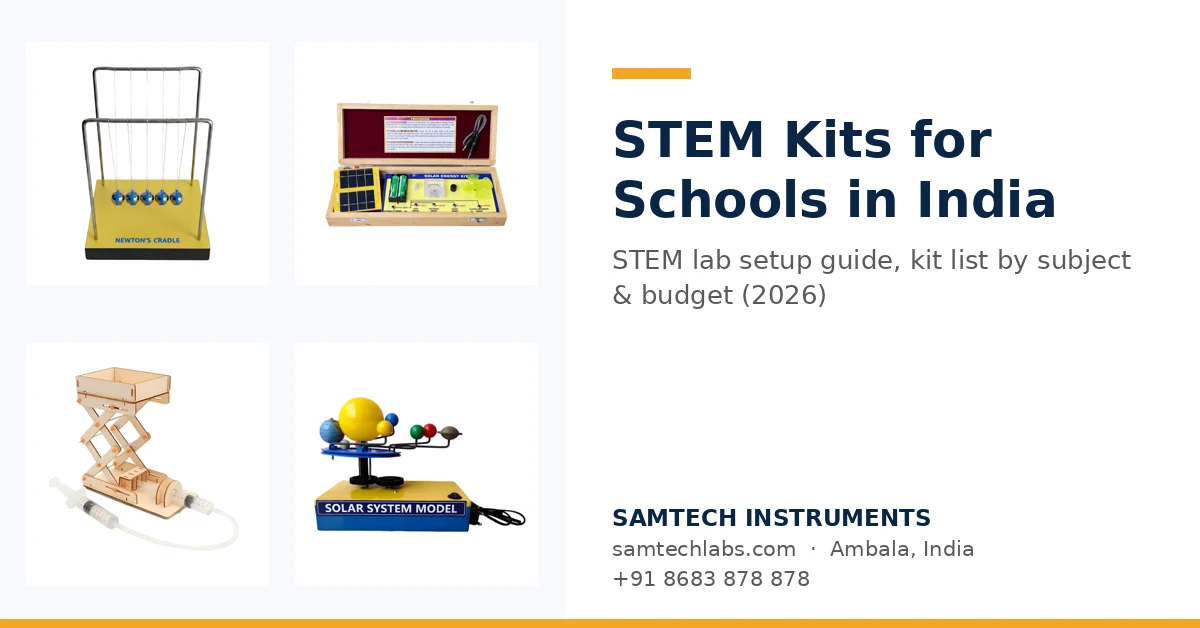
A school STEM lab is a room, or even one corner of a classroom, where students learn science, technology, engineering and maths by building and testing things instead of only reading about them. For Classes 6 to 10 the heart of it is a set of hands-on working models — a Newton’s cradle, a hydraulic jack, a solar energy kit, a laser optics kit — arranged by subject, with benches, open shelves and a simple activity calendar. The budget depends mainly on how many models and duplicates you need, so the same plan scales from one classroom corner to a full lab.
STEM stands for Science, Technology, Engineering and Mathematics. A STEM lab is a space where these subjects are taught together through activity: students see momentum pass through a row of steel balls, lift a load with a syringe-powered hydraulic jack, or measure how a solar panel’s output changes with the angle of light. The aim is to connect what is in the textbook with something students can hold, test and explain.
Schools often use three terms that overlap. This is how they differ in practice:
| Science lab | STEM lab | Atal Tinkering Lab (ATL) | |
|---|---|---|---|
| Main purpose | Board practicals and measurements | Concept learning through working models and projects | Innovation, prototyping and design thinking |
| Typical equipment | Glassware, chemicals, vernier calipers, optical bench | Working models, demonstration kits, maths manipulatives | Electronics, sensors, robotics kits, 3D printer, tools |
| Main users | Classes 9–12 | Classes 3–10 (models also used in 11–12) | Classes 6–12 |
| Usually funded by | School budget | School budget, PM SHRI, CSR | AIM grant-in-aid plus school funds |
In many schools the three share one room. A practical approach is to keep the board-practical apparatus in cupboards and put the STEM working models on open shelves where students can see them every day.
Three national programmes are pushing schools towards hands-on learning:
The result is that many principals now have to plan a lab quickly, often with a fixed budget and a deadline. The steps below are the order we suggest after supplying schools, colleges and mini science centres since 2002.
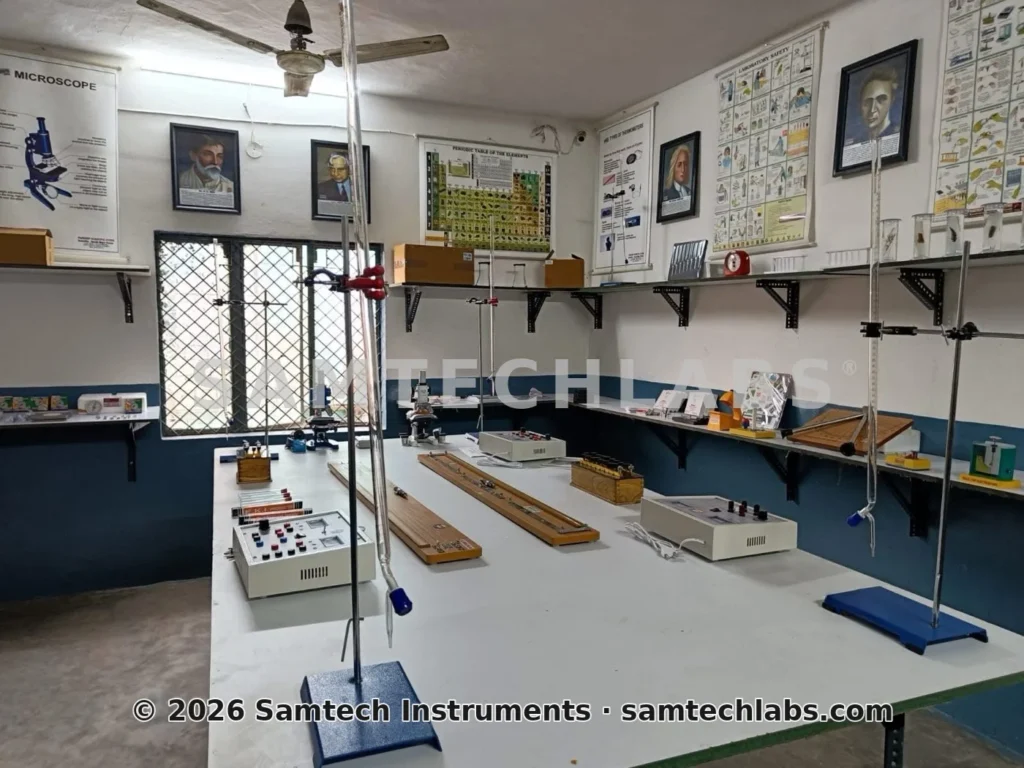
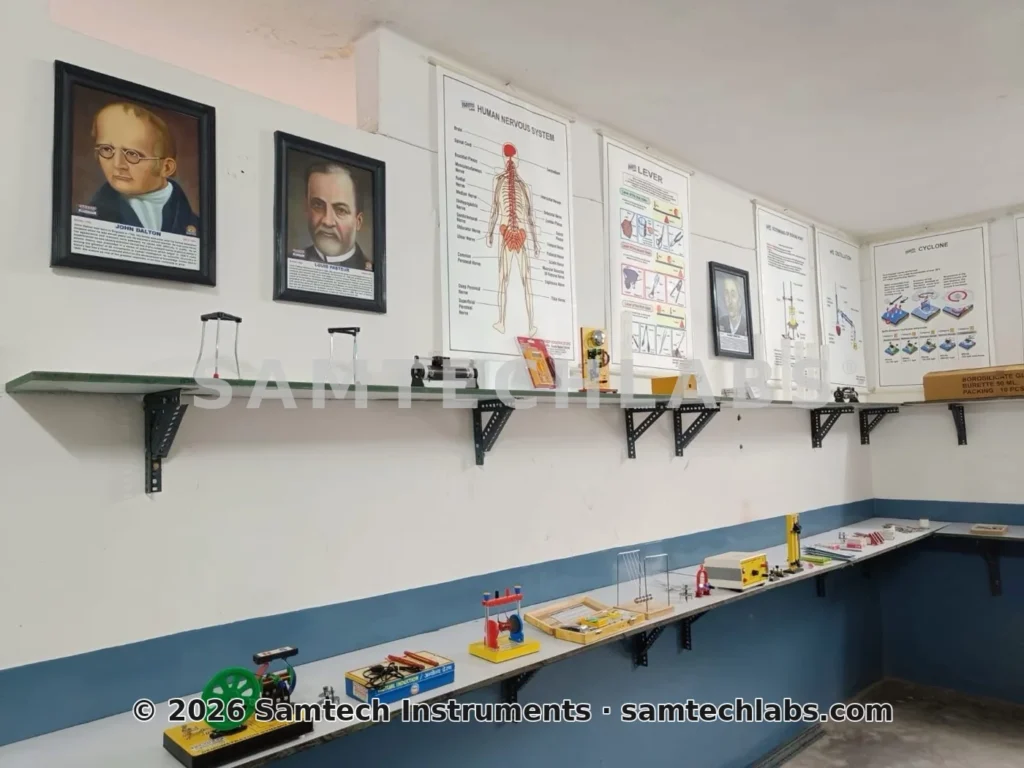
A one-minute walk through a school lab equipped with Samtech working models.
These are working models we manufacture and supply to schools. Tap any model to see its details; for school orders we send one consolidated quotation with GST and delivery.
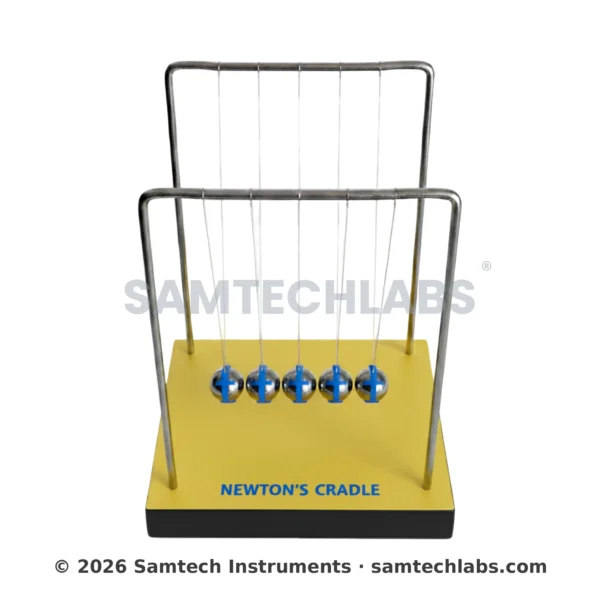 Newton’s Cradle ModelMechanics
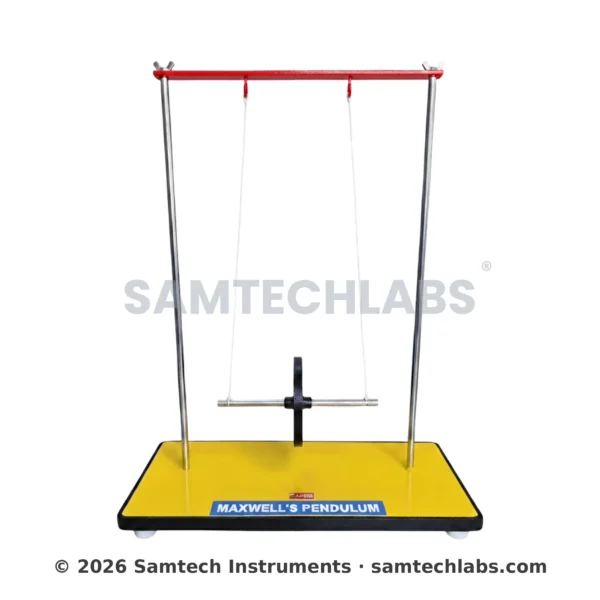 Maxwell Wheel ModelMechanics & energy
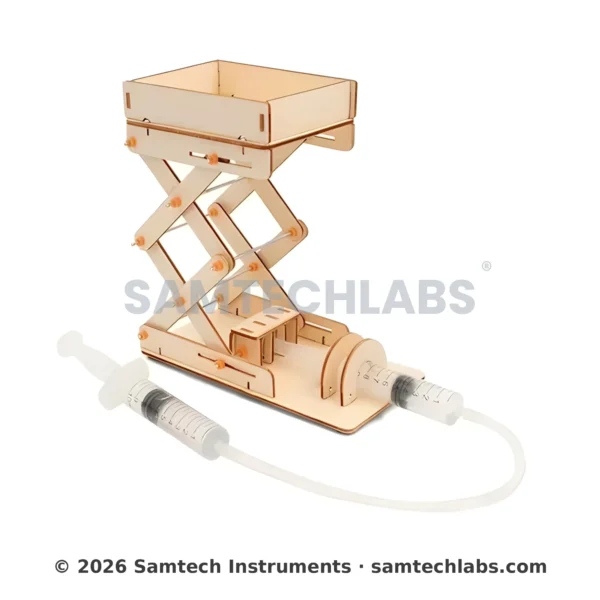 DIY Hydraulic Jack ModelEngineering
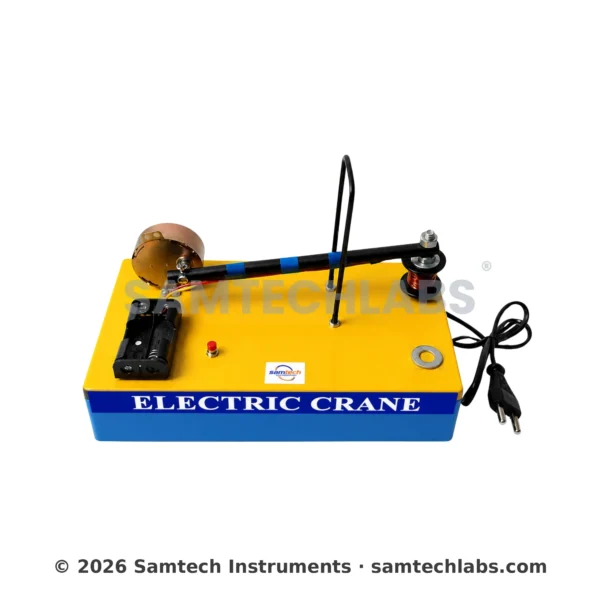 Electric Crane ModelElectricity & magnetism
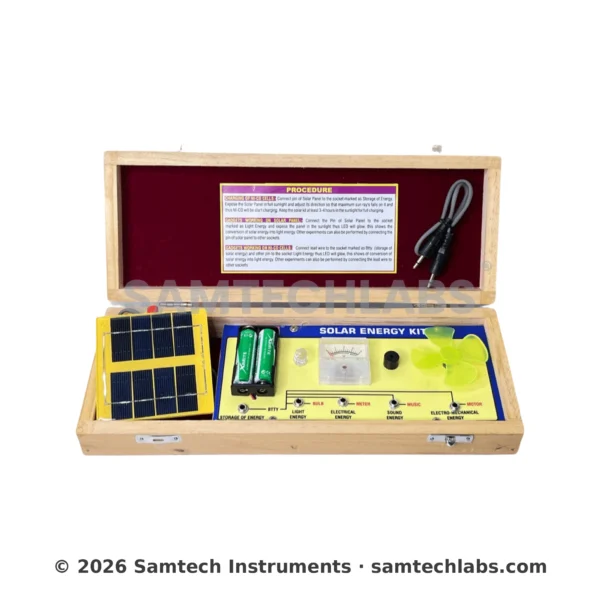 Solar Energy Kit 5 in 1Renewable energy
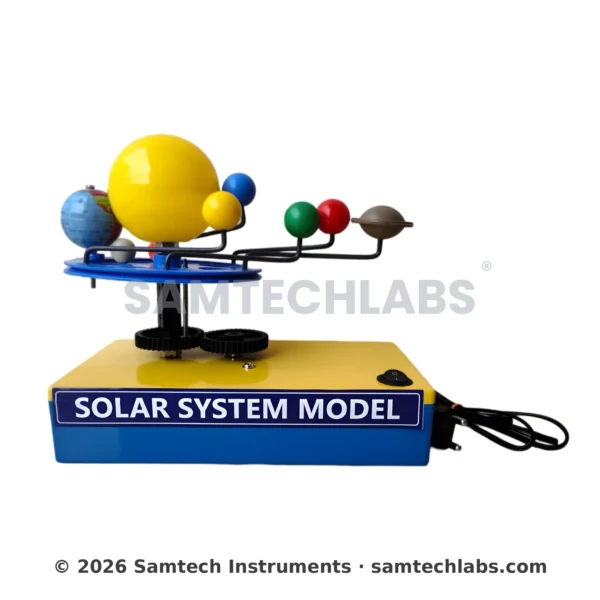 Solar System Working ModelAstronomy
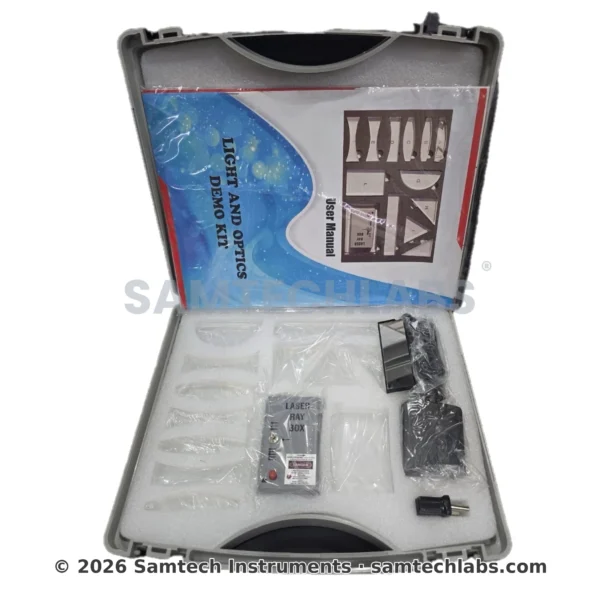 Laser Ray Optics KitLight & optics
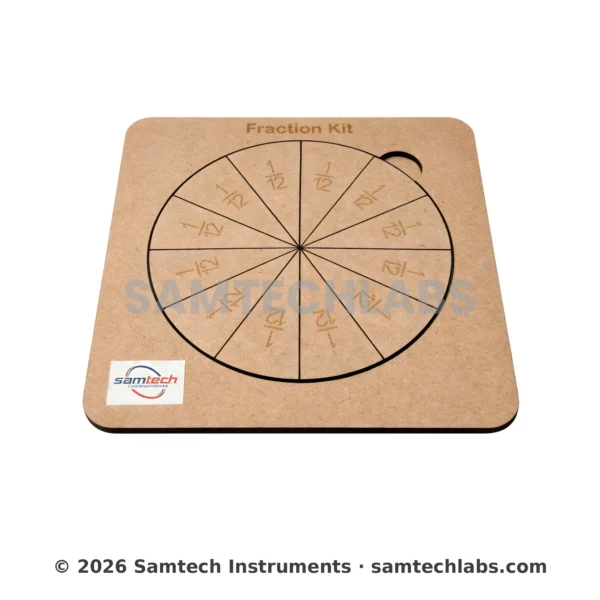 Fraction Wheel KitMaths
One or two models from each subject area is enough to start; tap any model to see details.
StemKits.in is Samtech Instruments’ dedicated store for science and STEM lab kits — browse by category, compare models and request a school quotation. ISO certified · MSME · GeM seller · GST invoice on all orders.
The most-used corner of any STEM lab. These make laws of motion and conservation of energy visible.
| Kit / model | What students learn |
|---|---|
| Newton’s Cradle Model | Conservation of momentum and energy in collisions |
| Maxwell Wheel Model | Conversion between potential and kinetic (rotational) energy |
| Gyroscope Working Model | Angular momentum and stability of a spinning body |
| Conservation of Momentum Kit | Momentum before and after a collision |
| Gravity Tower | Gravity, falling objects and balance |
| Centripetal Force Kit | Circular motion and the force towards the centre |
Good for project work: students can see the mechanism and change one variable at a time.
| Kit / model | What students learn |
|---|---|
| DIY Hydraulic Jack Model | Pascal’s law — a small force on one syringe lifts a load on another |
| Bernoulli Principle Apparatus | Pressure drops where airflow speed rises |
| Archimedes Principle Kit | Buoyant force and displaced liquid |
| Archimedes’ Screw Model | How a rotating screw lifts water |
| Pulley Demonstration Model | Mechanical advantage of fixed and movable pulleys |
| Kit / model | What students learn |
|---|---|
| Electric Motor Model | Electrical energy converted to rotation |
| Electric Bell Demonstration Model | Electromagnets and make-and-break circuits |
| Electric Crane Model | An electromagnet that can be switched on and off to lift iron |
| Fleming’s Left Hand Rule Apparatus | Direction of force on a current-carrying conductor |
| Domestic Circuit Apparatus | How fuses, switches and wiring work in a house |
| Lamps in Series Kit | Current and brightness in a series circuit |
Keep one corner of the room dark enough for these.
| Kit / model | What students learn |
|---|---|
| Laser Ray Optics Kit | Reflection and refraction through lenses, prisms and mirrors |
| Light and Optics Demo Kit | A complete set of optics demonstrations in one case |
| Infinity Mirror Model | Multiple reflections between parallel mirrors |
| Wooden Periscope | How two mirrors redirect light |
| Colour Shadow Apparatus | Mixing of coloured light and coloured shadows |
| Kit / model | What students learn |
|---|---|
| Wave Motion Apparatus – 18 Pulleys | Transverse wave motion, crest and trough |
| Powell’s Wave Demonstrator | Wave motion that a whole class can watch |
| Doppler Effect Kit | Change in pitch from a moving source |
| Reflection of Sound Model | Laws of reflection applied to sound |
| Tuning Fork Set of 8 | Frequency, pitch and resonance |
Popular with Classes 3–8 and with visitors. For a dedicated space corner, see the astronomy lab kits range.
| Kit / model | What students learn |
|---|---|
| Solar System Working Model | Order of planets and their orbits |
| Day and Night Working Model | Earth’s rotation and day/night |
| Phases of Moon Working Model | Why the Moon’s shape appears to change |
| Water Rocket Model | Action and reaction (Newton’s third law) |
| F36050 Astronomical Telescope | Observing the Moon and planets |
| Astronomy Lab Kit | A complete set of astronomy models in one kit |
More in the renewable energy kits & models range.
| Kit / model | What students learn |
|---|---|
| Solar Energy Kit 5 in 1 | Five solar experiments with a panel, motor and lamp |
| Windmill Model Kit | Wind energy converted to electricity |
| Water Turbine Model with Dynamo | Hydro power and how a dynamo works |
| Biogas Plant Working Model | How a biogas plant produces fuel |
| Solar Cooker Model | Concentrating sunlight to produce heat |
See the full maths kit range.
| Kit / model | What students learn |
|---|---|
| Pythagoras Theorem Kit | A visual proof of a² + b² = c² |
| Fraction Wheel Kit | Comparing and adding fractions |
| Decimal Abacus Model | Place value and decimals |
| Cuisenaire Strips Model | Number bonds, ratios and fractions |
Browse all 270+ models in the STEM kits category, or the full catalogue of 350+ kits on our STEM store, StemKits.in.
| Classes | Focus | Suggested models |
|---|---|---|
| 3–5 | Curiosity, observation, number sense | Solar system model, day and night model, periscope, fraction wheel, decimal abacus |
| 6–8 | One concept per model, hands-on use | Electric motor, electric bell, windmill kit, 5-in-1 solar kit, Archimedes principle kit, colour shadow apparatus, Pythagoras kit |
| 9–10 | Laws and quantities: motion, energy, waves, light, magnetism | Newton’s cradle, momentum kit, Maxwell wheel, wave motion apparatus, laser ray optics kit, Fleming’s rule apparatus, domestic circuit |
| 11–12 | Demonstrations alongside board practicals | Centripetal force kit, Bernoulli apparatus, Doppler effect kit, gyroscope, Powell’s wave demonstrator — plus a physics practical lab |
There is no single price for a STEM lab. The total depends on four things: how many models you choose, how many duplicates each class needs, whether you add ready kits such as the PM Shri Science Kit or Astronomy Lab Kit, and whether you buy single pieces or in bulk — bulk orders get a lower rate per piece. These are the four common ways schools start:
| Option | Good for | What it includes |
|---|---|---|
| Starter STEM corner | One wall of a classroom, Classes 3–8 | 20–25 working models across 5–6 subject areas |
| Ready science kit | Classes 6–10 | PM Shri Science Kit — a multi-box kit with optics items such as prisms, lens and mirror sets, a periscope, pinhole camera and telescope |
| Subject-wise STEM lab | Whole middle and secondary school | 80–120 models with duplicates, plus the Astronomy Lab Kit, an optics kit and maths kits |
| STEM + physics practical lab | Schools with Classes 9–12 | The above plus the CBSE Physics Lab Package for board practicals |
Get an exact quote: send us your kit list and class strength on WhatsApp and we’ll reply with one quotation covering GST, packing and delivery. Single-piece and bulk orders are priced differently.
If your school has an ATL grant: under AIM’s grant-in-aid guideline, each ATL school receives ₹20 lakh — ₹10 lakh as a one-time establishment cost and ₹2 lakh a year for five years for operations and maintenance. Of the establishment amount, up to ₹6.5 lakh is for equipment from AIM’s ATL equipment list, up to ₹50,000 for advanced prototyping, up to ₹1.5 lakh for laptops and a projector, and up to ₹1.5 lakh for refurbishment and furniture. Payments are made through PFMS (AIM guideline). Science working models complement the ATL list; they don’t replace it.
We manufacture science working models, demonstration apparatus and STEM kits for physics, chemistry, biology, astronomy, renewable energy and maths in our own factory in Ambala, Haryana, along with biology models and lab charts.
We do not make robotics, coding or electronics-prototyping kits, or 3D printers. If you are building an Atal Tinkering Lab, buy those from a specialist and use our models for the concept-learning side of the same room.
Samtech Instruments is a STEM kits manufacturer in India, based in Ambala and manufacturing since 2002. If you are equipping a full science department, our guides to the school science kit range and educational lab equipment cover the rest of the lab.
Samtech Instruments has manufactured lab equipment and STEM working models in Ambala, Haryana since 2002, supplying schools, colleges, mini science centres and dealers across India.
A STEM lab is a room or classroom corner where students learn science, technology, engineering and maths through hands-on working models and small projects, such as a Newton’s cradle, a hydraulic jack or a solar energy kit, instead of only reading about the concepts.
It depends on how many working models you choose, how many duplicates each class needs, whether you add ready kits, and whether you buy single pieces or in bulk. Bulk orders get a lower rate per piece. Share your kit list and class strength with Samtech Instruments for an exact quotation with GST and delivery.
Working models across mechanics, engineering and fluids, electricity and magnetism, light, sound, astronomy and renewable energy, plus maths manipulatives. Add two or three central benches, open wall shelves, power points along the benches and a corner that can be darkened for optics.
A STEM lab focuses on concept learning through working models. An Atal Tinkering Lab, funded through the Atal Innovation Mission, focuses on innovation and prototyping with electronics, sensors, robotics, 3D printing and tools. Many schools run both in the same room.
AIM’s guideline asks schools to spend the equipment part of the ATL grant on items from AIM’s ATL equipment list first; schools may buy additional equipment after that at their discretion. Science working models are usually bought from the school’s own science or PM SHRI budget. Always check the current AIM guidelines before ordering.
A normal classroom is enough for a full STEM lab. A starter STEM corner needs only one wall with two or three open shelves and a table for demonstrations.
Models that explain one idea clearly and can be handled by students: an electric motor and electric bell model, a windmill kit, a 5-in-1 solar energy kit, an Archimedes principle kit, a colour shadow apparatus and maths kits such as a Pythagoras theorem kit.
Yes. Samtech Instruments manufactures STEM kits in Ambala and supplies schools, mini science centres, dealers and exporters — single pieces as well as bulk quantities — with a GST invoice and pan-India delivery. Share your list on WhatsApp or call +91-86838-78878 for a quotation.
Learn the parts, working principle, uses and viscosity formula of an Ostwald viscometer with a clear explanation for laboratory students.
Understand stalagmometer parts, working principle, uses and surface tension formula with a simple guide for laboratory measurements.
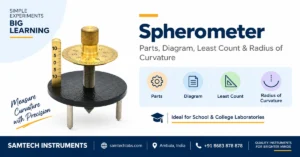
Learn spherometer parts, least count formula, working method and radius of curvature calculation with a clear physics lab guide.
No account yet?
Create an Account
Sign in to Samtech
One step with your Google account.
Added to cart
Sign in so this list is saved for your school or lab purchase team.
Continue with Google