


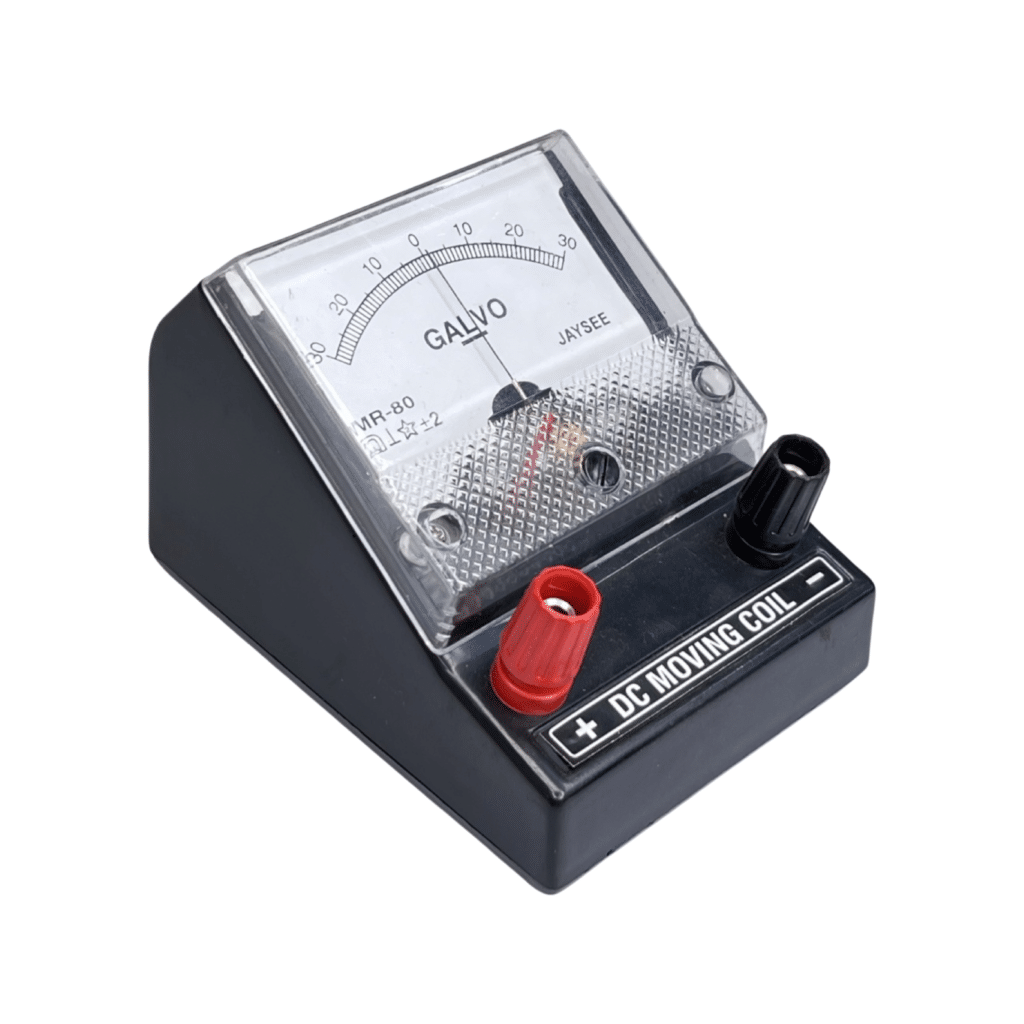
Moving-coil
Galvanometer
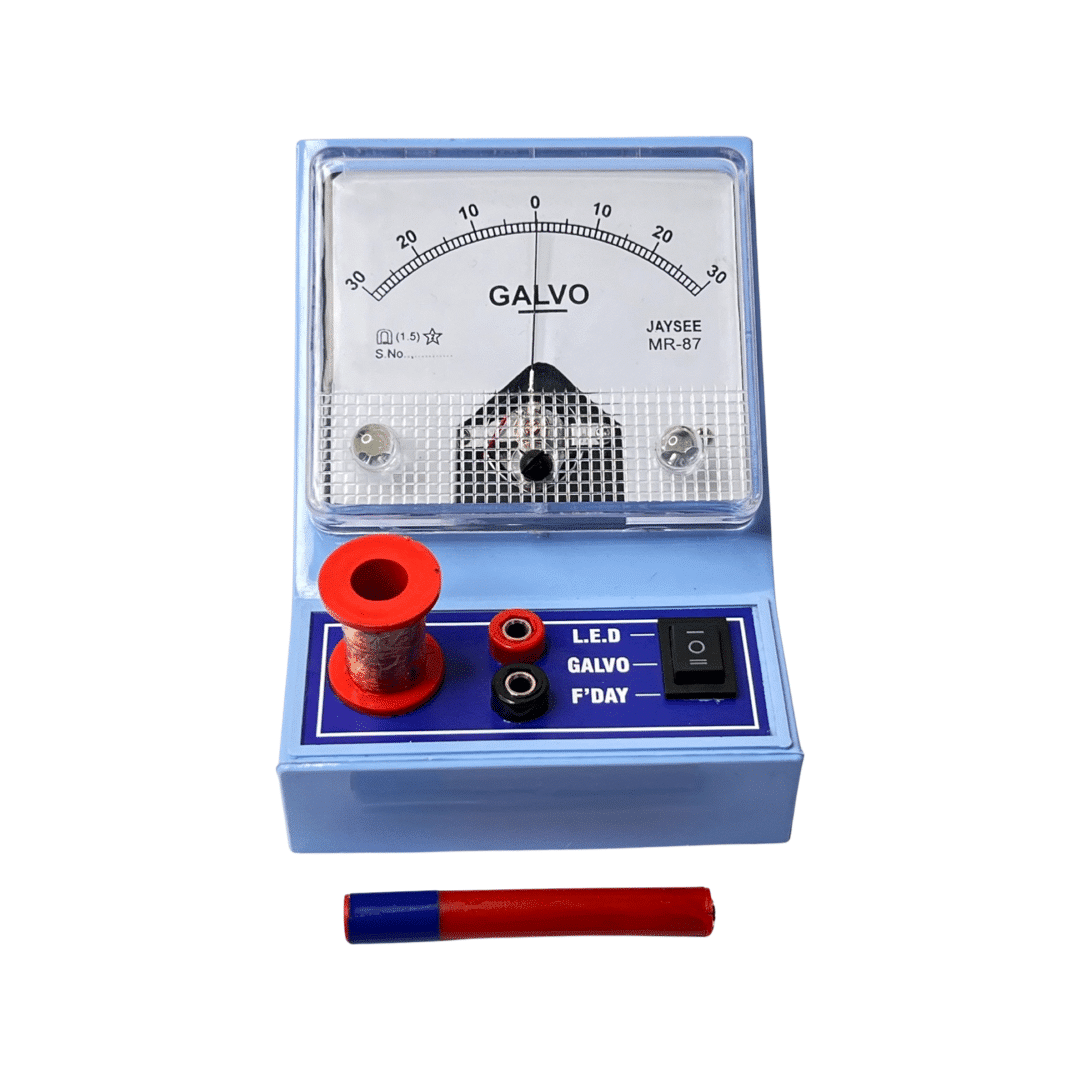
DC moving-coil galvanometer on an ABS stand with brass terminals. Centre-zero ranges such as 30-0-30 and 50-0-50.
₹135 (Exc. GST)
View product


+91 8683 878 878

Pan India Delivery

A galvanometer is a sensitive instrument used to detect and measure very small electric currents. It works on the principle that a current-carrying coil placed in a magnetic field experiences a turning force (torque), and the coil’s deflection is directly proportional to the current. Its pointer can swing both ways from a central zero, so it shows both the size of the current and the direction in which it flows.
A galvanometer is a sensitive electromechanical instrument that detects and measures very small electric currents in a circuit. While an ordinary ammeter is built to read larger currents, a galvanometer is designed to respond to tiny ones — often just a few microamperes — and to show which way they flow.
Its most recognisable feature is the centre-zero scale: the pointer rests in the middle and can swing either left or right. A deflection to one side means current is flowing one way; a deflection to the other side means it is flowing the opposite way. Because of this, a galvanometer is often used as a null detector — an instrument that tells you when no current is flowing at all, which is exactly what is needed in Wheatstone bridge and potentiometer experiments.
The idea goes back to Hans Christian Ørsted, who noticed in 1820 that a compass needle moves near a current-carrying wire. The instrument was later named after Luigi Galvani, and the tangent galvanometer was developed by William Thomson (Lord Kelvin). Today the galvanometer is the basic building block from which both the ammeter and the voltmeter are made.
A galvanometer works on a single, simple idea: a current-carrying coil placed in a magnetic field experiences a torque (a turning force). When current flows through the coil suspended between the poles of the magnet, the field pushes one side of the coil up and the other side down, twisting it.
This deflecting torque rotates the coil. As the coil turns, the hair-springs twist and push back with a restoring torque. The coil stops at the angle where the two torques balance:
Here N is the number of turns, I the current, A the area of the coil, B the magnetic field, k the restoring (spring) constant and θ the deflection. Rearranging gives the key result:
This proportionality is what makes measurement possible — read the angle, and you know the current.
The diagram above shows the main parts of a moving-coil galvanometer. The table explains what each one does — useful for the “label the diagram” and “state the function” exam questions.
| Part | Function |
|---|---|
| Permanent magnet | Provides a strong, steady magnetic field across the gap in which the coil sits. |
| Pole pieces (N & S) | Concave faces that, together with the core, create a radial field so the deflection stays proportional to the current. |
| Soft-iron core | A cylinder inside the coil that concentrates the field and makes it radial, increasing sensitivity. |
| Coil | Many turns of fine insulated wire wound on a light frame; it carries the current and experiences the torque. |
| Pointer | Attached to the coil; it moves across the scale to show how far the coil has turned. |
| Centre-zero scale | A graduated dial with zero in the middle, so the deflection can be read on either side. |
| Hair-springs (phosphor bronze) | Provide the restoring torque and also carry the current into and out of the coil. |
| Spindle / pivot | The axis on which the coil and pointer rotate. |
| Terminals | Connect the galvanometer into the external circuit. |
From the balance condition above, the deflection per unit current defines the current sensitivity of the galvanometer:
So a galvanometer is made more sensitive by increasing the number of turns (N), the coil area (A) or the field strength (B), or by reducing the spring constant (k). The soft-iron core helps here too: it makes the field radial, so the full turning force acts on the coil at every angle. The voltage sensitivity (deflection per unit voltage) is the current sensitivity divided by the coil resistance, NAB / kR.
Several designs exist, each suited to a different job:
| Type | Description |
|---|---|
| Moving-coil (D’Arsonval / Weston) | The most widely used type; a coil rotates in a magnet’s field. Forms the basis of most lab galvanometers and analog meters. |
| Ballistic | Designed to measure the total electric charge in a short current pulse rather than a steady current. |
| Tangent | Uses the horizontal component of the Earth’s magnetic field; the current is found from the tangent of the deflection angle. |
| Mirror (spot) | A tiny mirror reflects a light beam that acts as a long, weightless pointer for very sensitive readings. |
The galvanometer is the heart of most analog meters. Two simple changes turn it into the instruments used every day in the lab:
A galvanometer is one of the most useful instruments in a physics or electronics lab. Its main uses are to:
Seeing the pointer deflect for a real current is what makes the principle click for a class. These instruments are manufactured in India by Samtech Instruments for school and college physics labs.
DC moving-coil galvanometer on an ABS stand with brass terminals. Centre-zero ranges such as 30-0-30 and 50-0-50.
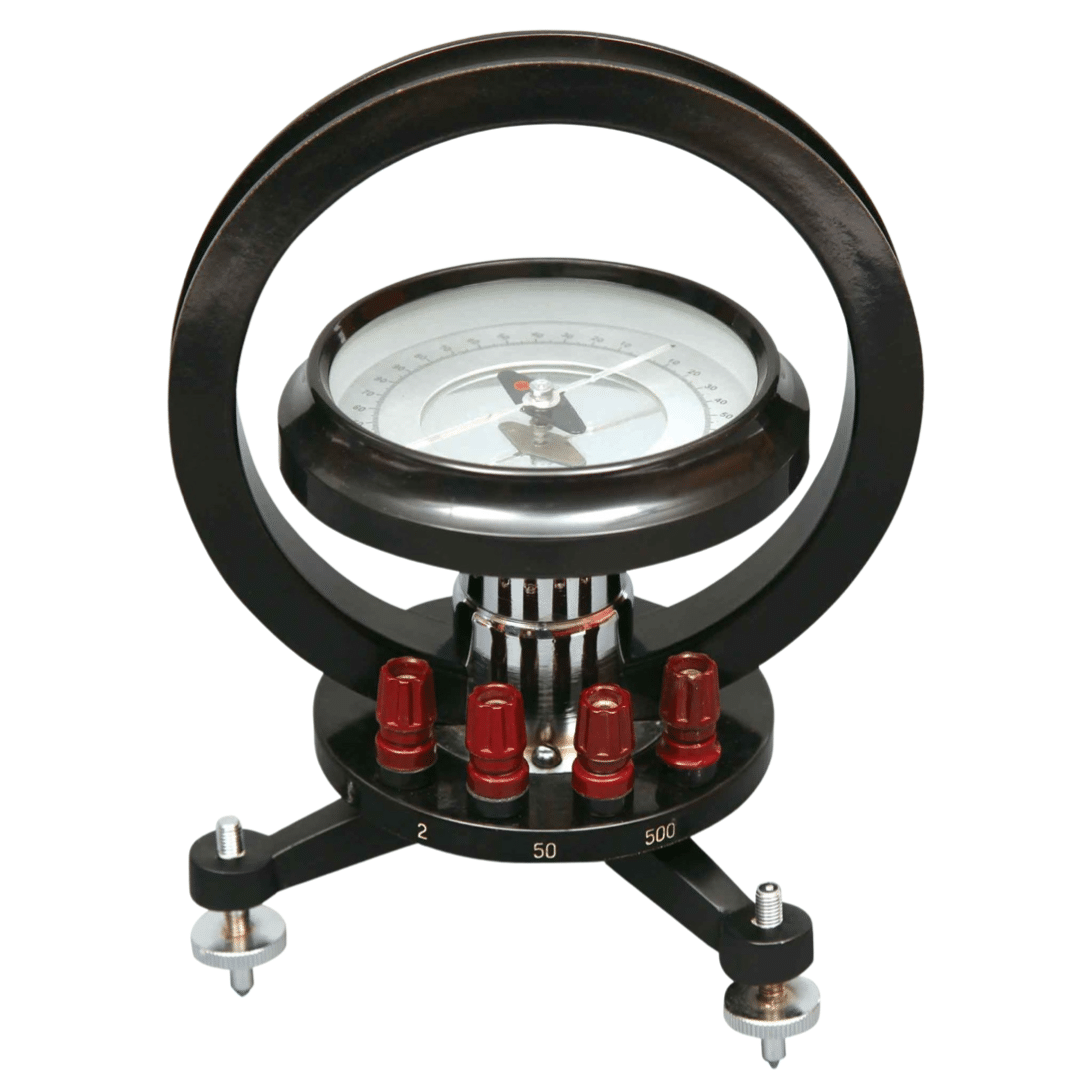
Uses the Earth’s magnetic field, with a 5″ compass (1° graduations) on a non-magnetic tripod base. Great for the tangent-law experiment.

Panel-mount moving-coil meter available in voltmeter, ammeter and galvanometer ranges, with a knife-edge pointer.
Schools, dealers and GeM buyers — supplied in bulk (MOQ 50). For dealer pricing or a quotation, call +91 8683 878 878.
A galvanometer works on the principle that a current-carrying coil placed in a magnetic field experiences a torque. The coil turns until this deflecting torque is balanced by the restoring torque of the springs, and the resulting deflection is directly proportional to the current.
A galvanometer detects very small currents and has a centre-zero scale, so it shows current in both directions. An ammeter measures larger currents in one direction and is, in fact, a galvanometer fitted with a low-resistance shunt connected in parallel.
By connecting a small resistance, called a shunt, in parallel with the galvanometer. The shunt carries most of the current, allowing the instrument to measure much larger currents safely.
By connecting a high resistance in series with the galvanometer. This limits the current through the coil and lets the instrument measure potential difference across two points.
The soft-iron core concentrates the magnetic field and makes it radial. A radial field keeps the magnetic force on the coil constant for any position, so the deflection stays directly proportional to the current and the sensitivity increases.
Sensitivity is the deflection produced per unit current. Current sensitivity equals NAB divided by k (turns × area × field, divided by the spring constant). A more sensitive galvanometer gives a larger deflection for the same small current.
For more detail on the galvanometer, these reference sources are a good next step:

How to set up a STEM lab in a school: room layout, a STEM kit list by subject and class, cost factors and ATL grant rules, from STEM kits manufacturer Samtech Instruments.

Learn the parts, working principle, uses and viscosity formula of an Ostwald viscometer with a clear explanation for laboratory students.

Understand stalagmometer parts, working principle, uses and surface tension formula with a simple guide for laboratory measurements.
No account yet?
Create an Account