







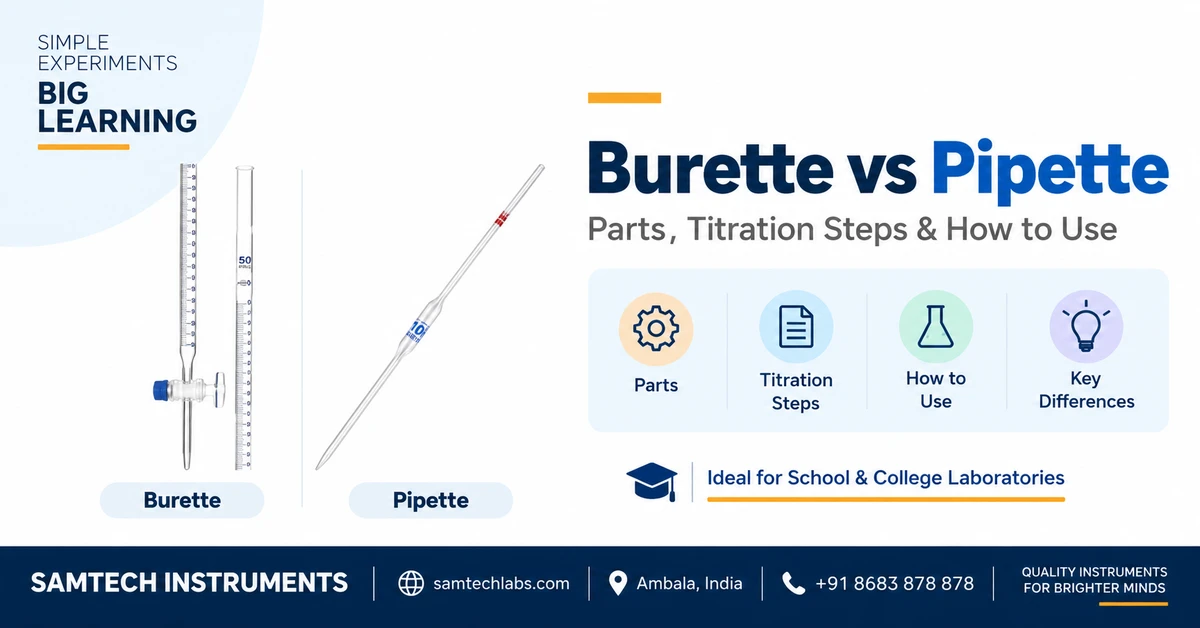

A burette delivers a variable, measured volume of liquid drop by drop through a stopcock, mainly for titrations. A pipette delivers one fixed, precise volume in a single transfer and has no tap. That single difference decides which one you reach for: burette when the exact amount depends on a reaction endpoint, pipette when you need to move a known volume quickly and accurately. Samtech Instruments has manufactured laboratory glassware in Ambala, India since 2002, supplying schools, colleges and institutions across India and 30+ countries.
This guide covers every part of both instruments with a labelled diagram, the full titration method step by step, how to read a burette without parallax error, the most common mistakes that throw off a result, and a buying guide for setting up a school titration station.
Key takeaways
- A burette = variable volume, has a stopcock, used for titration.
- A pipette = fixed volume, no stopcock, used to transfer a known amount once.
- Always read the meniscus with your eye level with the liquid surface to avoid parallax error.
- Rinse the burette with titrant (not just water) before filling it, to avoid dilution.
- Repeat titrations until you get concordant readings (within 0.1 mL) before averaging.
📑 Table of contents
Burette vs pipette: the basics
A burette is a long, graduated glass tube with a stopcock (tap) at the bottom. It is built to release liquid in a controlled, measurable way — a slow trickle or drop by drop — while you track the exact volume used. This makes it the standard tool for titration: gradually adding one solution (the titrant, in the burette) to another (the analyte, in a flask) until a reaction is complete.
A pipette has no tap. It is designed to transfer one known volume of liquid from one container to another, in a single action. A volumetric pipette (bulb-shaped) is calibrated to exactly one volume, marked by a single ring — used when you need the most accurate possible fixed transfer. A graduated pipette is a straight tube marked with multiple volume lines, so it can deliver any volume up to its capacity, at slightly lower accuracy than a volumetric pipette’s single mark.
Labelled diagram: burette and volumetric pipette
Burette vs pipette: difference table
| Property | Burette | Pipette |
|---|---|---|
| Volume delivered | Variable — you choose how much | Fixed (volumetric) or selectable up to a mark (graduated) |
| Control | Stopcock/tap — drop by drop | No tap — released in one go |
| Typical capacity | 25 mL, 50 mL, 100 mL | 1 mL to 50 mL, common sizes 10/20/25 mL |
| Reading | Read before and after; volume used = difference | Filled and emptied to the single mark |
| Main use | Titration (adding titrant to analyte) | Transferring a known volume of analyte or reagent |
| Typical accuracy | ±0.05–0.1 mL | ±0.02–0.06 mL (volumetric, more accurate) |
Parts and their functions
| Part | Instrument | Function |
|---|---|---|
| Graduated tube | Burette | Long precision-bore tube marked in mL, usually 0.1 mL divisions |
| Stopcock / tap | Burette | Glass or PTFE valve that controls the rate of liquid flow |
| Jet tip | Burette | Narrow outlet that releases liquid drop by drop |
| Meniscus | Both | The curved liquid surface; always read at the bottom (or top, for dark liquids) at eye level |
| Suction tip / bulb top | Pipette | Where a pipette filler or bulb is attached to draw liquid up |
| Bulb | Volumetric pipette | Wide central section that holds the calibrated fixed volume |
| Graduation / calibration mark | Pipette | Single ring (volumetric) or multiple lines (graduated) showing the exact fill level |
| Delivery tip | Pipette | Narrow lower opening that releases the measured liquid |
Titration: step by step
- Clean & rinse the buretteWash with distilled water, then rinse with a small amount of the titrant so leftover water doesn’t dilute it.
- Clamp it verticallyFix the burette in a stand with a clamp and check it’s perfectly upright.
- Fill above the zero markFill with titrant using a small funnel until the level is above 0.00 mL, then remove the funnel.
- Remove air bubbles from the tipOpen the tap briefly to flush out any trapped air below the stopcock.
- Take the initial readingEye level with the meniscus, note the reading to two decimal places.
- Add titrant to the flaskSwirl constantly. Add it fast at first, then drop by drop as the indicator starts to change colour.
- Record the endpoint readingStop at the permanent colour change, note the final reading, and subtract to get the titre.
- Repeat for concordant readingsRepeat 2–3 times until titre values agree within 0.1 mL, then average them.
How to read a burette correctly
Bring your eye exactly level with the liquid surface — not looking down or up at it. For clear or lightly coloured solutions, read the bottom of the meniscus (the curved dip in the surface). For dark, opaque solutions like potassium permanganate, read the top of the meniscus instead, since the bottom curve isn’t visible. Reading from the wrong angle is called parallax error and is the single most common source of titration mistakes.
Common mistakes to avoid
| Mistake | Effect on result | Fix |
|---|---|---|
| Air bubble in the jet tip | Sudden extra volume when it escapes — falsely high titre | Flush the tip fully before taking the initial reading |
| Reading at an angle (parallax) | Consistently high or low readings | Always bring eye level with the meniscus |
| Not rinsing burette with titrant | Titrant diluted by leftover water | Rinse with titrant solution before the final fill |
| Overshooting the endpoint | Titre too high, inaccurate concentration | Slow down and add drop by drop near the expected endpoint |
| Funnel left in burette while titrating | Extra drips add uncontrolled volume | Remove the funnel immediately after filling |
Setting up a titration station
🏫 Class 11–12 CBSE titration setup
The standard practical needs a burette, stand with clamp, pipette and conical flask together.
Glass Burette 50ml →🔩 Stopcock type
Choose glass stopcock for classic feel or rota (PTFE) stopcock for smoother, leak-free control.
Glass Stopcock → · Rota Stopcock →📐 Fixed-volume transfer
A volumetric pipette gives the most accurate single-volume transfer of your analyte before titrating.
Volumetric Pipette →🧪 Standard solutions
Preparing a titrant of exact concentration starts with a volumetric flask.
Volumetric Flask →Also useful: a burette stand with clamp (or a clamp only for an existing stand), a graduated pipette for variable transfers, a conical flask to hold the analyte, and pH paper as a quick indicator check.
Care & cleaning
Rinse both instruments with distilled water immediately after use — dried reagent residue is hard to remove and can affect future readings. Use a burette brush for the inside of the tube and stopcock bore. Store burettes vertically, tap closed, and pipettes horizontally or tip-down in a rack. Never force a stiff stopcock; a drop of stopcock grease (for glass taps) keeps it turning smoothly.
Setting up a titration station for your lab?
Samtech Instruments manufactures glass burettes, burette stands, volumetric and graduated pipettes, and conical flasks in Ambala — with bulk pricing for schools and colleges.
Why choose Samtech Instruments
A physics and chemistry lab glassware manufacturer based in Ambala, India — the country’s hub for laboratory equipment — supplying institutions since 2002.