







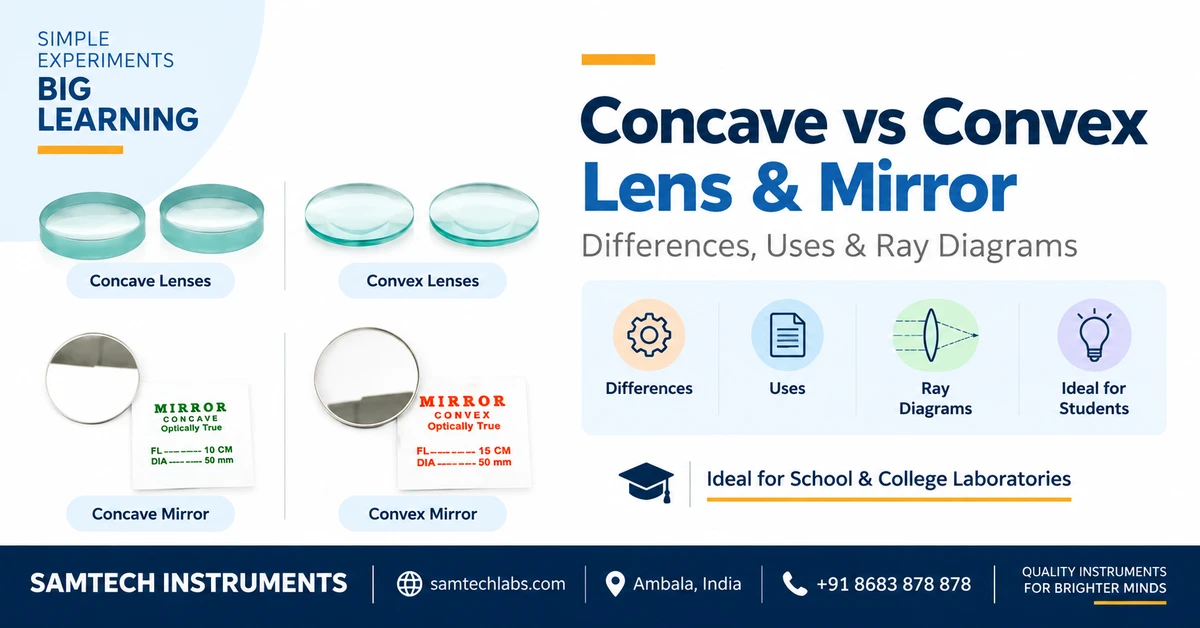

Concave means curving inward, convex means curving outward. A concave lens or mirror spreads light rays apart (diverging), while a convex lens or a concave mirror pulls light rays together to a focus point (converging) — a convex mirror, however, also diverges light, just from its outer curve. This one rule of curvature explains every use, from spectacles to vehicle mirrors to telescopes. Samtech Instruments has manufactured optical and physics lab instruments in Ambala, India since 2002, supplying schools, colleges and institutions across India and 30+ countries.
This guide covers the full picture: clear ray diagrams for all four types, side-by-side difference tables, real-world uses, a simple touch test to identify any lens or mirror without instruments, and the Hindi terms (अवतल/उत्तल) used in NCERT textbooks.
Key takeaways
- Concave = curves inward = diverges light (lens) or converges light (mirror).
- Convex = curves outward = converges light (lens) or diverges light (mirror).
- A convex lens and a concave mirror both converge light and can form real images.
- A concave lens and a convex mirror both diverge light and only form virtual images.
- Vehicle side mirrors are convex (wider field of view); shaving/makeup mirrors are concave (magnified close-up).
📑 Table of contents
What do concave and convex mean?
Concave describes a surface that curves inward, away from the viewer — like the inside of a bowl or a cave (the words share a root). Convex describes a surface that curves outward, toward the viewer — like the outside of a ball.
In optics this one idea decides everything: a concave lens is thinner in the middle than at the edges and always spreads light out; a convex lens is thicker in the middle and pulls light together. For mirrors it flips, because reflection works the opposite way: a concave mirror‘s inward-curving reflective surface pulls light together (like a satellite dish), while a convex mirror‘s outward-curving surface spreads light apart.
Ray diagrams: all four types compared
Concave lens vs convex lens
| Property | Concave lens | Convex lens |
|---|---|---|
| Shape | Thin at centre, thick at edges | Thick at centre, thin at edges |
| Also called | Diverging lens | Converging lens |
| Effect on parallel rays | Spreads them apart | Brings them to a focus |
| Focal length sign | Negative | Positive |
| Image formed | Always virtual, upright, smaller | Real (usually) or virtual & magnified (object closer than F) |
| Common use | Myopia (short-sight) glasses | Magnifying glass, camera lens |
Concave mirror vs convex mirror
| Property | Concave mirror | Convex mirror |
|---|---|---|
| Shape | Reflecting surface curves inward | Reflecting surface curves outward |
| Also called | Converging mirror | Diverging mirror |
| Effect on parallel rays | Brings them to a focus | Spreads them apart |
| Focal length sign | Negative (in front of mirror) | Positive (behind mirror) |
| Image formed | Real & inverted (far), virtual & magnified (close) | Always virtual, upright, smaller |
| Common use | Shaving mirror, torch reflector | Vehicle side mirror, security mirror |
Real-world uses at a glance
| Type | Everyday example | Why this one is used |
|---|---|---|
| Concave lens | Spectacles for myopia; peepholes | Spreads rays so they focus correctly on a short eyeball / widens viewing angle |
| Convex lens | Magnifying glass; camera & telescope objective | Converges rays to magnify or form a sharp real image on film/sensor |
| Concave mirror | Shaving/makeup mirror; headlight & torch reflector; solar cooker | Converges light — magnifies up close, or focuses light/heat into a beam |
| Convex mirror | Vehicle side mirror; shop security mirror; blind-turn road mirror | Always gives a smaller, full, upright view — widest field of view of any mirror |
How to identify one — no instruments needed
- Feel the edges (lens)Run a finger from centre to edge. Thinner at the edges = convex. Thicker at the edges = concave.
- Look through the lensHold it over printed text. Convex magnifies (bigger); concave shrinks (smaller). Both stay upright.
- Check the mirror’s curveCurves inward like a spoon’s bowl = concave. Bulges outward like a spoon’s back = convex.
- Look at your reflection up closeConcave shows a magnified, upright face close-up (and flips upside-down further away). Convex always shows a smaller, upright face — this is exactly why it’s used in vehicle mirrors.
Which one does your lab need?
🏫 Class 10 CBSE ray-optics practicals
The syllabus needs all four: concave lens, convex lens, concave mirror and convex mirror, mounted on an optical bench.
Optical Bench Set →🔬 Individual lenses & mirrors
Buying separately for a larger lab or replacement stock — available in standard focal lengths and diameters.
Concave Lens → · Convex Lens →🪞 Demonstration & fun physics
A funny mirror set makes concave/convex distortion visible instantly for younger students and science exhibitions.
Funny Mirror Set →🔭 Astronomy & advanced optics
Convex objective lenses are the heart of a refracting telescope — a natural extension of this topic for senior students.
Astronomical Telescope →Also useful: a lens holder to mount lenses upright during ray-tracing, and a laser ray box or reflection of light apparatus to trace and photograph the actual ray paths shown in the diagram above.
Handling & care
Lenses and mirrors are precision glass — always hold them by the edges or rim, never touch the optical surface with fingers. Clean only with a soft lens cloth or tissue in gentle circular strokes; never use rough cloth, which scratches the coating. Store in the padded case or box provided, away from direct sunlight (a convex lens left in the sun can focus enough heat to start a fire) and away from dusty benches.
Setting up ray-optics apparatus for your lab?
Samtech Instruments manufactures concave lenses, convex lenses, concave mirrors, convex mirrors and complete optical bench sets in Ambala — with bulk pricing for schools and colleges.
Why choose Samtech Instruments
A physics and biology instrument manufacturer based in Ambala, India — the country’s hub for laboratory equipment — supplying institutions since 2002.