



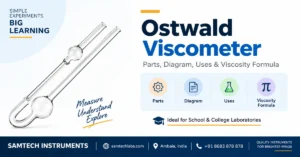
Ostwald Viscometer: Parts, Diagram, Uses & Viscosity Formula
Learn the parts, working principle, uses and viscosity formula of an Ostwald viscometer with a clear explanation for laboratory students.


+91 8683 878 878

Pan India Delivery

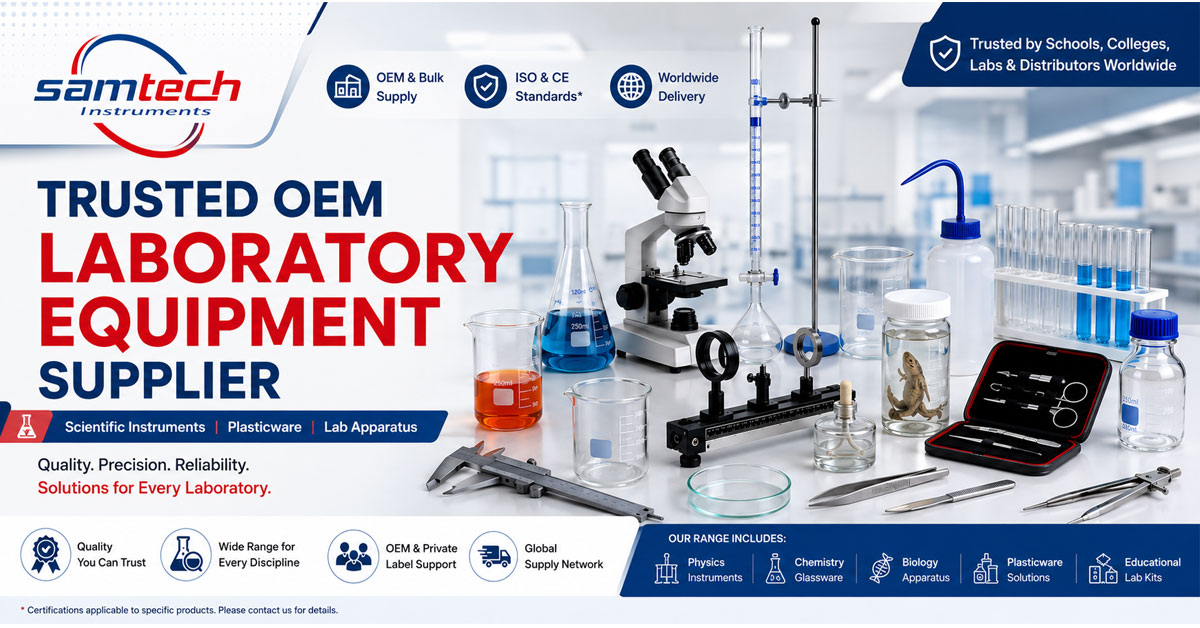
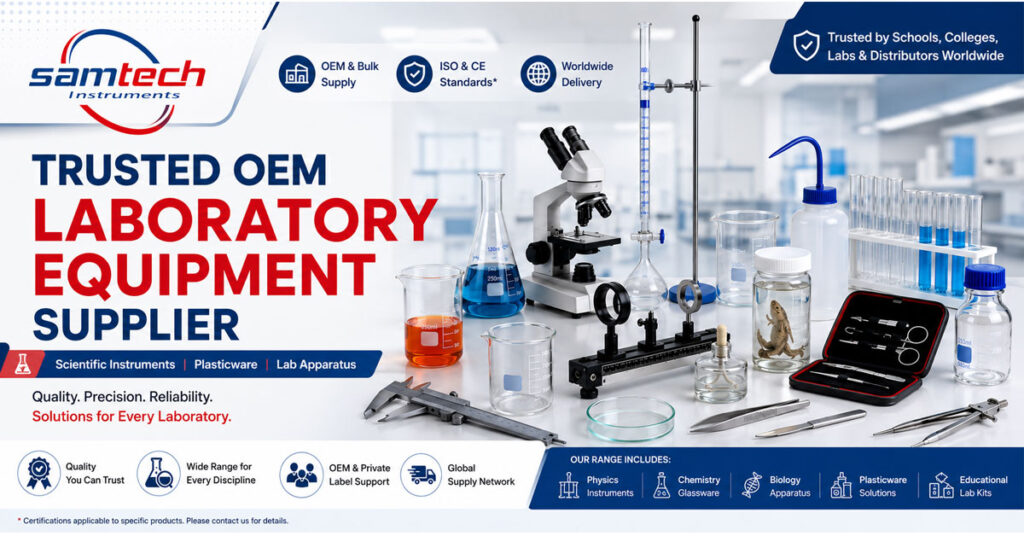
Whether you are equipping a school science laboratory, university facility, training institute or commercial testing environment, the suitability and consistency of scientific instruments directly affect how effectively experiments, demonstrations and routine laboratory work can be performed.
Finding a trusted OEM laboratory equipment supplier is therefore about more than choosing products from a catalogue. Buyers, distributors and procurement teams need clear specifications, dependable supply, appropriate materials, responsive support and equipment suited to the intended application.
Samtech supplies scientific instruments and laboratory apparatus for educational, institutional and practical laboratory applications. Its product range covers physics, chemistry and biology laboratories, including measuring instruments, experimental apparatus, laboratory glassware, plasticware, educational charts and practical-lab accessories.
This guide explains what to consider when sourcing scientific equipment, introduces common laboratory apparatus and their uses, explores laboratory plasticware supplier solutions, and explains how distributors and institutions can evaluate OEM manufacturing and scientific-equipment suppliers more effectively.
A laboratory equipment supplier provides scientific instruments, apparatus, glassware, plasticware and accessories used to measure, observe, heat, hold, transfer or analyse materials and to support experiments, demonstrations and practical education.
Depending on its capabilities, a supplier may serve schools, colleges, universities, distributors, exporters, research environments and institutional procurement teams. An OEM laboratory equipment manufacturer may additionally support private labelling, custom packaging, bulk production and specification-based manufacturing where available.
Laboratory equipment directly influences how experiments are performed, demonstrated and understood. For distributors and institutional buyers, inconsistent specifications, unsuitable products or unreliable supply can create operational problems extending far beyond a single order.
A trusted OEM laboratory equipment supplier should therefore offer more than product availability. Buyers should evaluate:
For buyers sourcing multiple scientific categories, working with a broad equipment supplier may also simplify procurement by reducing the number of separate vendors needed for physics, chemistry, biology and general laboratory requirements.
OEM laboratory equipment manufacturing refers to producing scientific instruments or laboratory apparatus for another company, distributor or brand according to agreed product specifications and commercial requirements.
Depending on the product and manufacturer’s capabilities, OEM services may include:
OEM arrangements can be useful for scientific-equipment distributors, educational suppliers, laboratory procurement businesses and brands seeking to expand their catalogue without establishing manufacturing facilities for every individual product category.
The available options depend on the apparatus involved. A basic laboratory accessory may offer different customisation possibilities from a precision measuring instrument or electrical experimental apparatus. Buyers should therefore discuss specifications, quantities, branding, packaging and destination requirements before finalising an OEM order.
For broader educational and institutional requirements, buyers can also explore Samtech’s physics laboratory equipment and school science kits.
When buyers search for an ISO & CE certified scientific equipment manufacturer, they are generally looking for stronger confidence signals related to quality management, process consistency, product conformity and documentation.
ISO certification can relate to an organisation’s management or quality systems, depending on the applicable standard. Buyers should verify the exact standard, certification scope and current validity.
CE marking applies to products covered by relevant European Union legislation. It should not be treated as a blanket certification automatically applicable to every product manufactured or supplied by a company.
Before selecting a manufacturer or supplier, procurement teams should verify:
Procurement tip: For Samtech’s exact certification and product-compliance details, request current documentation applicable to the specific product or order under consideration.
Laboratory plasticware supplier solutions include reusable or disposable plastic laboratory products designed for sample handling, storage, measurement, transfer, rinsing and other scientific procedures.
While laboratory glassware remains essential for many applications, plasticware can offer practical advantages such as lightweight handling, resistance to breakage and availability in different materials, capacities and configurations. Buyers can explore Samtech’s laboratory plasticware range for relevant product options.
Plastic laboratory products should not, however, be selected solely because they are lightweight or resistant to breakage. The suitability of a product depends on factors such as:
Plastic containers can also support selected educational and specimen-storage applications. For example, zoology specimens supplied in plastic jars illustrate how suitable containers can be used for specimen preservation, handling and educational display.
Common laboratory apparatus are tools and instruments used to measure, observe, heat, hold, transfer, store or analyse materials and to demonstrate scientific principles. Their exact uses vary according to the laboratory discipline, experiment and required level of accuracy.
Understanding common laboratory apparatus and their uses helps students, educators, procurement teams and laboratory buyers select suitable equipment more confidently. The table below connects common instruments with their primary applications and relevant laboratory areas.
| Laboratory Apparatus | Primary Use | Common Laboratory Area |
|---|---|---|
| Vernier caliper | Measuring external dimensions, internal dimensions and depth with precision | Physics and engineering labs |
| Glass burette | Accurately dispensing measured volumes of liquid, particularly during titration | Chemistry labs |
| Reagent bottle | Storing chemical reagents and prepared laboratory solutions | Chemistry and general labs |
| Spirit lamp | Providing a compact flame for suitable basic laboratory heating procedures | Chemistry and educational labs |
| Optical bench | Supporting controlled optical experiments involving lenses, mirrors and light sources | Physics and optics labs |
| Dissection box | Providing instruments used for biological dissection and specimen study | Biology and educational labs |
| Six’s maximum and minimum thermometer | Recording the highest and lowest temperatures reached over a period | Meteorology and environmental studies |
| Tripod stand | Supporting suitable vessels during laboratory heating procedures | Chemistry labs |
| Ostwald viscometer | Determining liquid viscosity through capillary flow under controlled conditions | Chemistry and physics labs |
| Laser ray box | Demonstrating reflection, refraction and other geometrical optics principles | Physics and optics labs |
| Glass prism | Demonstrating refraction, dispersion and deviation of light | Physics and optics labs |
| Petri dish | Holding, observing or working with suitable laboratory samples and specimens | Biology and general labs |
Physics laboratories use apparatus to demonstrate and measure principles involving mechanics, optics, electricity, magnetism and heat. Examples include optical benches, laser ray boxes and parallelogram law apparatus.
Chemistry laboratories require apparatus for measuring, storing, transferring, heating and analysing substances. Examples include glass burettes, reagent bottles and Ostwald viscometers.
Biology laboratories use instruments and accessories for specimen examination, dissection, observation and practical demonstrations. A biology dissection box, for example, provides instruments for routine specimen dissection and study.
Glassware and plasticware each have distinct advantages. The appropriate choice depends on the intended laboratory application, chemicals involved, temperature conditions, accuracy requirements and handling environment.
| Factor | Laboratory Glassware | Laboratory Plasticware |
|---|---|---|
| Breakage resistance | Can break if dropped or mishandled | Generally more resistant to impact |
| Weight | Usually heavier | Usually lightweight |
| Heat resistance | Depends on glass type and intended application | Varies significantly by polymer |
| Chemical compatibility | Depends on glass composition and chemical involved | Depends strongly on polymer type |
| Reusability | Many products can be reused when properly cleaned and maintained | Can be reusable or disposable, depending on product |
| Selection priority | Glass type, capacity, accuracy and thermal requirements | Polymer type, chemical compatibility, temperature and sterility requirements |
A buyer evaluating scientific equipment should begin with the intended application rather than comparing products solely on price.
Identify the scientific principle, experiment or procedure the equipment needs to support. Apparatus intended for classroom demonstration may differ from equipment required for quantitative measurement.
Check relevant specifications such as measurement range, least count or resolution, capacity, dimensions, construction material, graduation, power requirements and included components.
Equipment for secondary-school practicals may have different requirements from apparatus intended for colleges, universities, training environments or specialised laboratory applications.
Consider whether the apparatus will be exposed to heat, chemicals, repeated handling, moisture or other operating conditions.
Do not assume every laboratory product requires identical certification. Ask for documentation relevant to the exact product and destination market.
For distributors and institutional buyers, consistency across repeat orders can be as important as the initial purchase.
If private labelling, custom packaging or specification modifications are required, discuss them before finalising the order.
Institutions, distributors and laboratory setup partners often need more than a one-time purchase. They may require repeatability, category continuity and a supplier capable of supporting a broader buying journey from product selection to reorder planning.
Potential benefits of working with an OEM-oriented scientific equipment supplier include:
Successful OEM procurement depends on clear requirements. Buyers should communicate the product, quantity, intended application, destination market, branding needs, packaging preferences and any mandatory compliance requirements.
Buyers can learn more about the organisation on the Samtech company information page or explore the wider product catalogue through the laboratory equipment shop.
To receive a more accurate quotation and reduce unnecessary back-and-forth, provide as much relevant information as possible in the initial enquiry.
For multi-product procurement, providing a structured requirement list or bill of quantities can make evaluation and quotation significantly more efficient.
Whether you are sourcing common laboratory apparatus for an educational institution, expanding a scientific-equipment catalogue, exploring laboratory plasticware supplier solutions or evaluating OEM manufacturing possibilities, clear technical and commercial requirements are the best place to begin.
Send Samtech your product list, required quantities, destination, specifications and any OEM, branding, packaging or documentation requirements.
Learn the parts, working principle, uses and viscosity formula of an Ostwald viscometer with a clear explanation for laboratory students.
Understand stalagmometer parts, working principle, uses and surface tension formula with a simple guide for laboratory measurements.
Learn spherometer parts, least count formula, working method and radius of curvature calculation with a clear physics lab guide.
No account yet?
Create an Account